

A Complete Guide to PDPA IT Compliance for Clinics in Singapore (2026 Edition)
In Singapore’s increasingly digital healthcare environment, data privacy and trust are no longer optional — they are obligations.
Whether you run a dental clinic, a general practice, or a specialist centre, you handle personal and medical data every single day. Under Singapore’s Personal Data Protection Act (PDPA), failure to secure that data properly could result in fines, legal action, or loss of patient trust.
Yet many clinics still rely on outdated IT setups, unsecured storage, or vague SOPs when it comes to handling patient records.
This guide explains exactly what your IT systems must include to ensure PDPA IT compliance for clinics in Singapore, and how aligning with the Cyber Trust Mark framework can build even greater confidence among patients and partners.
What is PDPA, and Why Should Clinics Care?
The Personal Data Protection Act (PDPA) governs how organizations in Singapore collect, use, and store personal data. For clinics, this includes:
Medical records
Appointment histories
Identification numbers (NRIC, FIN, Passport)
Contact details and payment information
Insurance-related data
Common clinic violations include:
Storing unencrypted patient records on personal devices
No documented IT access policy
Staff sharing login credentials
Insecure backups or cloud storage
No audit logs to track access
These may seem minor, but they can lead to serious regulatory breaches and compromise patient safety and trust.
What Your IT System Must Include for PDPA Compliance
To stay compliant and reduce your legal risk, your clinic’s IT setup must include the following core elements:
I. Data Encryption (At Rest & In Transit)
All patient data must be encrypted, whether stored locally, on a server, or in the cloud.
💡 Use full disk encryption (e.g., BitLocker) for workstations, and ensure your cloud provider uses industry-standard encryption protocols (AES-256, TLS 1.2+).
II. Role-Based Access Control (RBAC)
Not every staff member should have access to all patient data.
Your systems must support:
Tiered access based on role (admin, nurse, dentist, etc.)
Unique logins — never shared
Session timeouts and automatic logouts
This reduces internal misuse and limits the damage if an account is compromised.
III. Access Logs & Audit Trails
Your IT system should record:
Who accessed what records
When and from where
What changes were made
Essential for investigations and demonstrating compliance during audits.
IV. Secure Backups & Disaster Recovery Plan
Backups must be:
Encrypted
Regular (daily recommended)
Stored offsite or in the cloud
Tested regularly for recoverability
Losing access to patient records due to ransomware or system failure without a working backup can cripple a clinic — and violate PDPA.
V. Endpoint Protection & Firewall
All devices handling personal data must be protected from malware, phishing, and intrusions.
Install and maintain an enterprise-grade antivirus
Use firewalls with intrusion detection/prevention
Block unauthorised USB access or file transfers
Bonus: Invest in a Unified Threat Management (UTM) appliance to monitor all traffic and enforce security policies.
VI. PDPA-Compliant Cloud Storage
If your clinic uses cloud platforms to store data (e.g. EMRs, imaging, records), ensure:
The cloud provider is based in Singapore or has Singapore data centres
They meet local data residency and security standards
Service Level Agreements (SLAs) include security and privacy clauses
Providers like Microsoft Azure Singapore, Amazon AWS (Singapore region), and certain MOH-approved platforms are ideal.
VII. Staff Cybersecurity Training
Under PDPA, data protection isn’t just IT’s job — it's everyone’s responsibility.
Train staff on:
Recognizing phishing emails
Using strong passwords
Avoiding unsecured devices
Following SOPs for data handling
Regular refresher courses help reduce accidental breaches and demonstrate a “reasonable effort” to stay compliant.
What is the Cyber Trust Mark — and Why Should Clinics Care?
The Cyber Trust Mark is a certification launched by the Cyber Security Agency of Singapore (CSA) to recognize organizations with strong cybersecurity practices.
For clinics, it signals:
High cybersecurity maturity
Strong commitment to protecting patient data
Greater trust among patients, partners, and insurers
Readiness for future regulatory audits or partnerships
While PDPA is mandatory, the Cyber Trust Mark is voluntary — but powerful. Achieving it gives your clinic a clear edge in patient confidence and business credibility.
💡 Advance IT helps clinics not only meet PDPA baseline compliance, but also prepare for Cyber Trust Mark certification by aligning your IT systems with CSA-recommended controls.
🛠️ PDPA-Ready IT Systems in Action (Checklist)
Here’s what a fully PDPA-compliant IT setup looks like in a modern clinic:
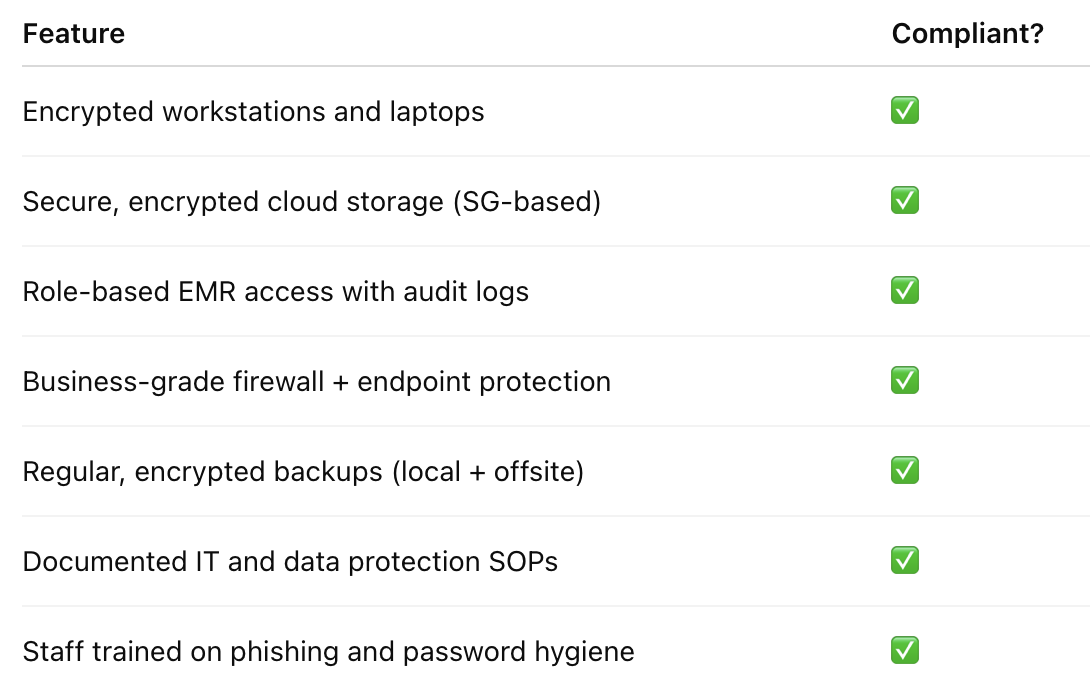
Not sure if your clinic ticks every box? That’s what an IT compliance audit is for.
Common Mistakes That Lead to PDPA Breaches in Clinics
Using free or consumer-grade cloud tools (e.g. Dropbox, Google Drive without encryption)
Leaving laptops unlocked or unattended at the front desk
Backing up to USB drives with no password protection
Relying on one technician with no structured IT policy
No incident response plan when a breach occurs
These issues are fixable — but only if you know they exist.
How Advance IT Helps Clinics Achieve Compliance, and Confidence
Advance IT has worked with dental and medical clinics across Singapore to implement secure, PDPA-ready IT infrastructure.
Our approach includes:
On-site IT audit and risk assessment
Setup or upgrade of compliant systems (hardware + software)
Staff training and documentation
Support for Cyber Trust Mark preparation
Ongoing support via our structured team model (Helpdesk, Engineers, System Admins)
We don’t just check boxes — we build reliable, secure systems that let you focus on patient care.
Final Thoughts: Compliance is the Baseline — Trust is the Goal
PDPA compliance isn’t just a legal checklist. It’s a signal to your patients that their data is safe with you.
By investing in proper IT systems, training, and support, your clinic can avoid costly breaches, stay audit-ready, and deliver care with confidence.
And if you’re aiming higher — towards Cyber Trust Mark certification — now’s the time to start laying that foundation.
📞 Ready to Audit or Upgrade Your Clinic’s IT?
Let’s start with a free discovery call and on-site assessment.
We’ll show you where you stand — and what you need to get compliant, secure, and trusted.
🔗 Book Your PDPA IT Audit with Advance IT
Compliance you can prove. Systems you can trust.
····························································
With over 15 years of experience and a strong focus on IT support and Managed IT, we’re proud to have 99.5% of our customers staying with us long-term.
‣ Website: https://www.advanceit.sg/
‣ Address: 8 Burn Road, #11-11 Trivex Singapore 369977
‣ Email us at: contact@advanceit.sg
‣ Call our team: +65 6592 8458








Is your Singapore clinic ready for the Health Information Act? Learn the 2027 HIA deadline, NEHR requirements, cybersecurity rules and practical steps private clinics should take now.