

Disaster Recovery Planning for Small Clinics: A Simple Guide
How to Build a Practical, Cost-Effective Disaster Recovery Plan for Healthcare Clinics
In the world of healthcare, patient trust and continuous operations are everything. But what happens when your clinic’s systems go down due to a ransomware attack, hardware failure, or a power outage?
Unfortunately, many small clinics in Singapore still lack a formal disaster recovery plan, leaving them exposed to costly downtime, data loss, and compliance risks.
The good news? Creating a disaster recovery plan for healthcare clinics doesn’t have to be complicated or expensive. With the right approach, even small practices can be prepared for the worst and bounce back fast.
This guide breaks down what disaster recovery actually means, why it’s critical for clinics, and how to build a DR plan that protects your patients, your data, and your reputation.
What Is a Disaster Recovery Plan (DRP)?
A Disaster Recovery Plan (DRP) is a documented, step-by-step guide that outlines how your clinic will:
Respond to unexpected IT incidents (e.g., cyberattacks, server crashes)
Minimise service disruption during a crisis
Recover essential systems, patient data, and operations
Ensure business continuity, compliance, and patient care
For healthcare clinics, a DRP is not just an IT best practice; it’s a patient safety measure.
Why Disaster Recovery Planning Is Crucial for Clinics
In a healthcare setting, even a few hours of downtime can:
Delay or cancel patient treatments
Lose access to Electronic Medical Records (EMRs)
Risk exposure of sensitive patient data
Damage your clinic’s reputation and patient trust
Lead to non-compliance with Singapore’s PDPA and MOH data protection regulations
With rising ransomware threats and stricter compliance audits, every clinic - no matter the size - needs a reliable disaster recovery plan.
Established in 2009, Advance IT is a Singapore-based IT services provider recognized for its commitment to reliability and transparency. Specializing in IT Support and Managed IT Services, we empower diverse industries, including SMEs, SMBs, and the healthcare sector, with tailored solutions that enhance productivity, security, and scalability.
What Should a Disaster Recovery Plan Include?
Here’s a simple, actionable breakdown of what your disaster recovery plan for healthcare clinics should contain:
Risk Assessment
Start by identifying the biggest threats to your clinic’s operations:
Cyberattacks (ransomware, phishing)
Power outages or internet failures
Server or hardware failure
Human error (accidental data deletion)
Fire, flooding, or natural disasters
Prioritise threats based on likelihood and impact, not just worst-case scenarios.
Data Backup Strategy
Your most valuable asset is your patient data. Backups must be:
Performed automatically (daily or real-time)
Stored both on-site and off-site (e.g., cloud backups)
Encrypted to protect against breach
Versioned to recover from accidental deletions
Regularly tested for restore success
Pro tip: Cloud backup solutions are ideal for small clinics; they’re secure, scalable, and affordable.
Recovery Objectives: RTO & RPO
These define how fast and how recent your recovery will be:
RTO (Recovery Time Objective): How quickly do you need to get back online? (e.g., within 1 hour)
RPO (Recovery Point Objective): How much data can you afford to lose? (e.g., 15 minutes of work)
Set realistic RTO/RPO targets based on your clinic’s operations.
Roles & Responsibilities
Clearly assign tasks to team members in the event of a disaster:
Who contacts IT support?
Who notifies patients of disruptions?
Who initiates the data recovery process?
Even in small clinics, role clarity prevents panic and speeds up recovery.
Recovery Procedures
Document how you’ll recover critical systems and services, such as:
EMR software and database
Email and communication tools
Appointment systems
Payment processing
Network infrastructure (routers, firewalls)
Include step-by-step instructions and login credentials in a secure, offline location.
Communication Plan
Your DRP should outline how to communicate with:
Internal staff (doctors, nurses, admin)
Patients (SMS, phone, social media)
IT vendors or service providers
Authorities (MOH or PDPC, in case of data breach)
Transparent communication builds trust, even during a crisis.
Testing & Updating
A DRP isn’t one-and-done. Clinics should:
Test recovery processes at least twice a year
Update the plan when systems or staff change
Document lessons from any real incidents
Advance IT helps clinics simulate real-world scenarios to ensure recovery plans actually work.
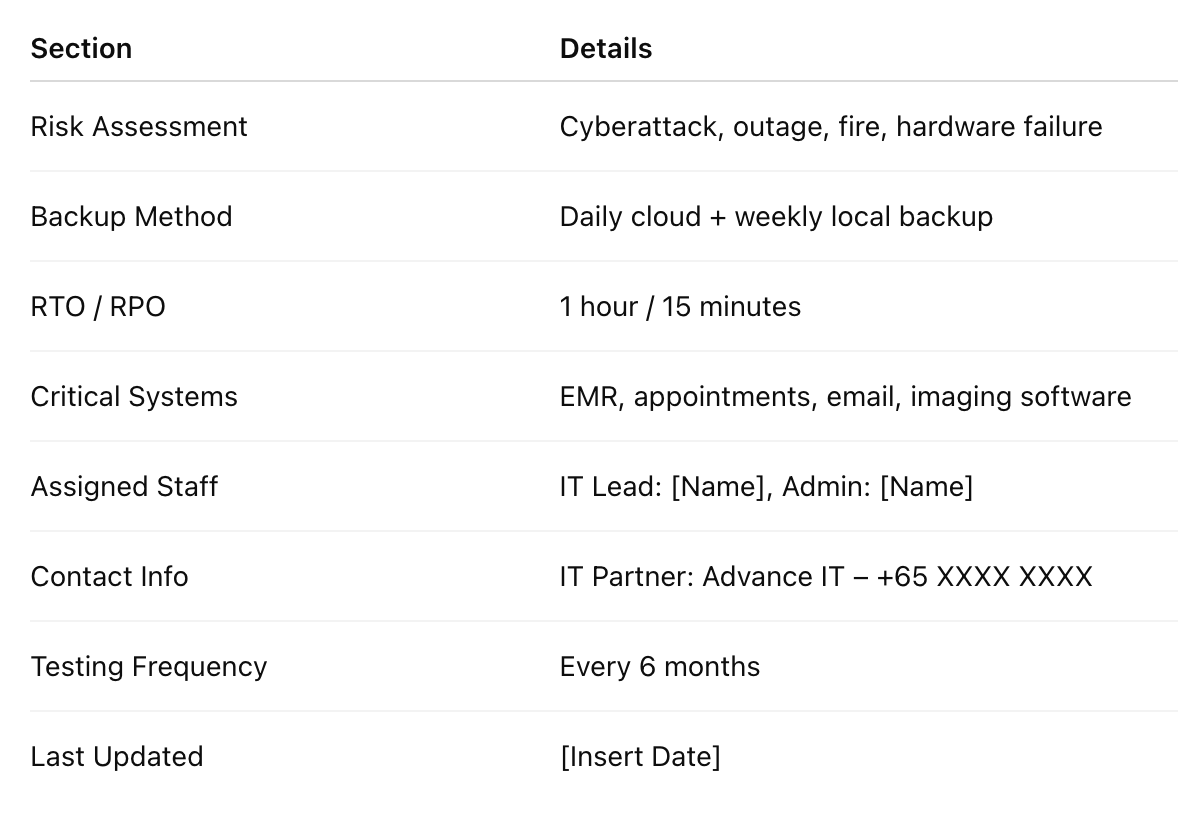
Disaster Recovery Plan Template for Small Clinics
Here’s a quick template you can use to get started:
How Advance IT Supports Disaster Recovery for Clinics
At Advance IT, we help Singapore-based clinics build, test, and maintain disaster recovery plans tailored to their needs, without complexity or inflated costs.
Our DRP services include:
Risk & infrastructure assessment
Secure, automated backup systems (cloud + local)
RTO/RPO planning and system prioritisation
DRP testing and simulation
Full recovery support when incidents happen
With our team-based support model (Helpdesk, Onsite Engineers, System Admins), you’ll never face a crisis alone.
PDPA & MOH Compliance Matters
Singapore’s PDPA requires healthcare providers to protect personal data from loss, unauthorised access, and corruption. A disaster recovery plan helps you:
Stay compliant
Respond quickly to incidents
Prove your readiness during audits or investigations
Maintain trust with patients and partners
And as ransomware becomes more sophisticated, regulators increasingly expect clinics to show they have DR plans in place.
Final Thoughts: Plan Now, Recover Later
Disasters don’t give you a warning. A strong, simple disaster recovery plan gives your clinic:
Peace of mind
Faster recovery
Less financial impact
Protection for patients and their data
If you don’t have a DR plan or haven’t reviewed it in the last 12 months, now’s the time to act.
Ready to Build or Review Your Clinic’s Disaster Recovery Plan?
Let’s start with a discovery call and free on-site assessment. We’ll help you assess your risks and create a practical, cost-effective DR plan tailored to your clinic.
🔗 Schedule Your Free DRP Consultation with Advance IT
····························································
With over 15 years of experience and a strong focus on IT support and Managed IT, we’re proud to have 99.5% of our customers staying with us long-term.
‣ Website: https://www.advanceit.sg/
‣ Address: 8 Burn Road, #11-11 Trivex Singapore 369977
‣ Email us at: contact@advanceit.sg
‣ Call our team: +65 6592 8458
Related Posts













Is your Singapore clinic ready for the Health Information Act? Learn the 2027 HIA deadline, NEHR requirements, cybersecurity rules and practical steps private clinics should take now.