

Cyber Trust Mark 2027: What Every Singapore Clinic and SME Must Know About SS 712:2025 and HIA
If you run a clinic or SME in Singapore, you may have heard that cybersecurity requirements are changing ahead of 2027.
But there are actually two important developments that businesses should not confuse:
Singapore's Cyber Security Agency (CSA) has replaced the old Cyber Trust (2022) framework with the enhanced Cyber Trust (2025), published as Singapore Standard SS 712:2025.
Under the Health Information Act (HIA), healthcare providers will progressively have to meet cybersecurity and data security requirements, with GP clinics among the first groups reaching their implementation deadline in September 2027.
For Singapore clinics, the second change is particularly important.
For SMEs outside healthcare, Cyber Trust certification generally remains a cybersecurity certification rather than a universal 2027 legal requirement. However, the direction is clear: customers, regulators and larger organisations are increasingly expecting businesses and their vendors to demonstrate stronger cybersecurity governance.
Here is what Singapore businesses need to understand, and what they should start preparing now.
Quick Answer: What Is Changing With the Cyber Trust Mark?
The Cyber Trust Mark is a national cybersecurity certification developed by the Cyber Security Agency of Singapore (CSA) for organisations with more extensive digital operations and higher cybersecurity risk.
The previous Cyber Trust (2022) framework is no longer in use from February 2026. It has been replaced by Cyber Trust (2025), which has been published as Singapore Standard SS 712:2025 - Tiered cybersecurity standards for organisations. The enhanced framework expands cybersecurity beyond traditional IT systems and addresses emerging technology risks including:
Classical IT cybersecurity;
Cloud security;
Operational Technology (OT) security; and
AI security.
Cyber Trust continues to use a risk-based approach. Instead of treating cybersecurity as a generic checklist, organisations assess their risk profile and implement controls appropriate to their level of exposure.
This makes the framework increasingly relevant to digitally dependent Singapore businesses.
Is Cyber Trust Mark Mandatory for Every Singapore SME by 2027?
No. This is one of the most important distinctions for business owners.
There is currently no general requirement stating that every Singapore SME or private clinic must obtain Cyber Trust certification by 2027. CSA has, however, introduced mandatory Cyber Trust requirements for certain cybersecurity and Critical Information Infrastructure organisations.
For example:
Licensed cybersecurity service providers providing specified services are required to maintain at least Cyber Trust Promoter (Level 3);
CII auditors are required to achieve the relevant Cyber Trust requirement by the end of 2026; and
Critical Information Infrastructure owners will be required to achieve Cyber Trust Advocate (Level 5) for relevant non-CII systems by the end of 2027.
For most ordinary SMEs, Cyber Trust remains a way of demonstrating a mature, risk-based cybersecurity posture rather than a blanket regulatory requirement.
Then why should SMEs pay attention?
Because the cybersecurity expectations surrounding their customers, vendors, and supply chains are becoming stronger. A company may not be legally required to obtain Cyber Trust itself, but it could increasingly encounter questions such as:
How do you protect customer information?
Do you enforce Multi-Factor Authentication (MFA)?
How do you manage administrator accounts?
How often are systems patched?
Are backups regularly tested?
How do you manage cybersecurity incidents?
What controls apply to third-party IT vendors?
How do you secure cloud systems?
Who is responsible for cybersecurity within the organisation?
For SMEs serving healthcare, finance, government, enterprise or other security-sensitive customers, being able to answer these questions is increasingly important.
What Changed Under Cyber Trust (2025)?
The enhanced Cyber Trust framework reflects how much business technology has changed since the earlier standard was introduced. A modern SME may now depend on Microsoft 365, cloud applications, remote access, SaaS platforms, AI tools, outsourced IT providers, and multiple external vendors.
Cybersecurity therefore cannot stop at installing antivirus software and a firewall. CSA's enhanced Cyber Trust certification explicitly expands its coverage to three major technology areas.
1. Cloud Security
Singapore businesses increasingly store email, files, applications, and customer information in cloud environments.
But moving to the cloud does not automatically transfer every cybersecurity responsibility to the cloud provider.
Businesses still need to manage areas such as user identities, permissions, privileged accounts, MFA, configuration, data access, backups, monitoring, and employee security practices.
The enhanced Cyber Trust framework helps organisations address these cloud-specific risks.
2. AI Security
AI is rapidly entering everyday business operations.
Employees may use AI tools for writing, analysis, customer service, coding, or processing internal information.
That creates new questions around what information employees are allowed to enter into AI systems, who can access AI applications, and how AI-related risks are governed.
The enhanced Cyber Trust framework therefore introduces security considerations for organisations using AI.
3. Operational Technology Security
For businesses operating industrial equipment, production environments or other operational technology, cybersecurity incidents can affect more than office computers. This is especially relevant to sectors such as manufacturing, engineering, logistics, infrastructure, and industrial operations.
Cyber Trust (2025) allows organisations to consider these risks as part of their broader cybersecurity posture.
What Does Cyber Trust Mark 2027 Mean for Singapore Clinics?
For clinics, there is another major cybersecurity development that is arguably more urgent than Cyber Trust certification itself: the Health Information Act (HIA).
Singapore's HIA establishes requirements around the collection, access, sharing, and protection of health information.
Licensed healthcare providers will progressively be required to contribute specified health information to the National Electronic Health Record (NEHR) while implementing required cybersecurity and data security measures.
The implementation is being introduced in batches.
Current HIA implementation timeline
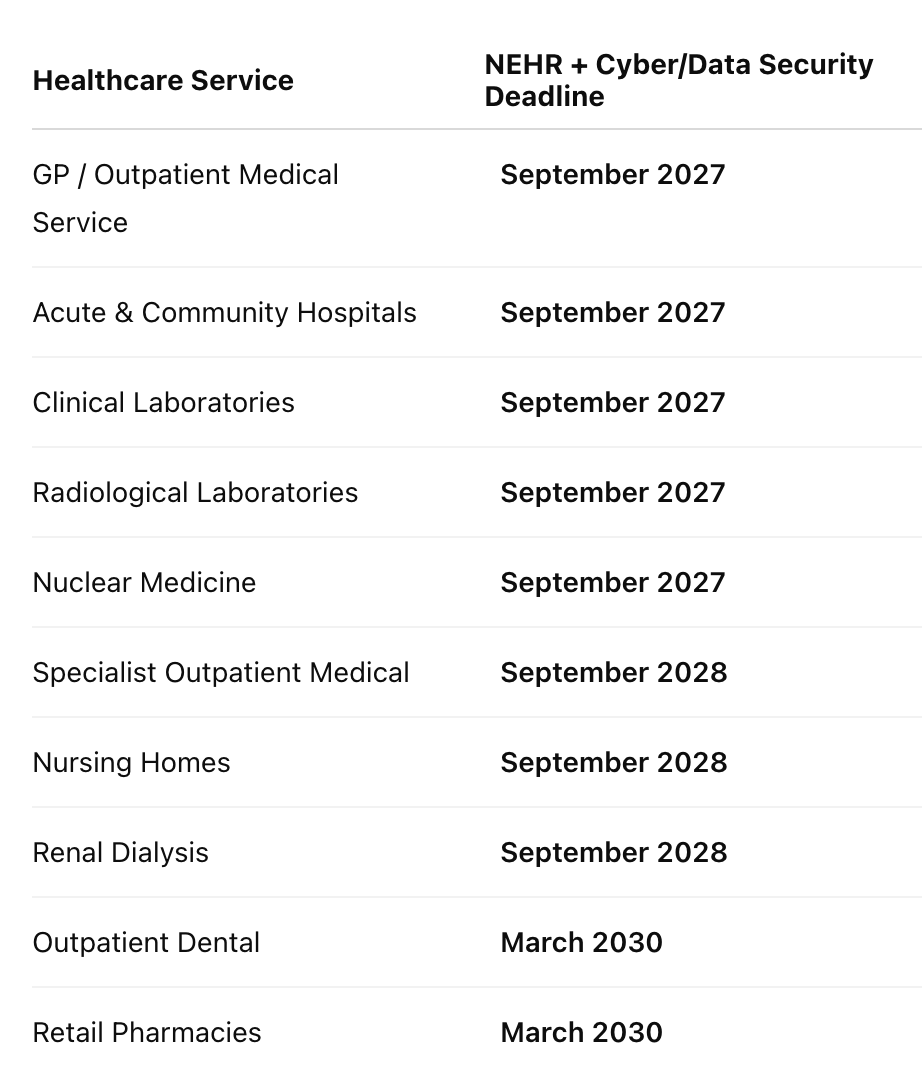
For a typical private GP clinic, September 2027 is therefore the date to pay attention to.
Waiting until 2027 to begin cybersecurity preparation could create unnecessary pressure.
What Cybersecurity Measures Will Clinics Need Under HIA?
MOH has issued Cybersecurity and Data Security (CS/DS) Essentials for Healthcare Providers to set out cybersecurity and data security requirements under HIA. The requirements recognise that a solo GP clinic does not have the same IT resources as a hospital.
MOH has specifically stated that the requirements are intended to include essential controls aligned with CSA cyber-hygiene standards and to remain suitable for smaller healthcare providers, including solo practitioners. For clinic owners, this changes an important mindset: Cybersecurity is no longer simply an IT vendor issue.
It becomes part of operating a healthcare organisation responsibly. Your clinic should therefore know:
what systems contain patient information;
who has access to them;
how accounts and passwords are managed;
whether systems receive security updates;
whether endpoint protection is working;
how backups are performed;
whether backups can actually be restored;
how vendors access clinic systems;
what happens when an employee leaves;
how cybersecurity incidents are identified and escalated; and
who is responsible for responding to an incident.
HIA Also Introduces Cyber Incident Reporting Requirements
Cybersecurity preparation is not only about preventing attacks. Healthcare providers also need to be prepared to respond when something goes wrong. Under HIA requirements, providers must report a confirmed cybersecurity incident or data breach that meets the relevant criteria to MOH.
Providers must provide an initial report within two hours, followed by a detailed incident report within 14 days. This makes incident preparation particularly important.
Imagine discovering suspicious activity on a clinic computer at 9:00 AM.
Who investigates it? Who decides whether patient information may have been affected?
Who contacts your IT provider? Who documents the incident? Who determines whether MOH needs to be notified?
Where are your system logs? Can compromised accounts be disabled immediately?
A clinic that only starts answering these questions after an incident occurs is already behind.
Cyber Trust Mark vs Cyber Essentials: Which Does an SME Need?
Another common source of confusion is the difference between Cyber Essentials and Cyber Trust. They serve different cybersecurity maturity levels.
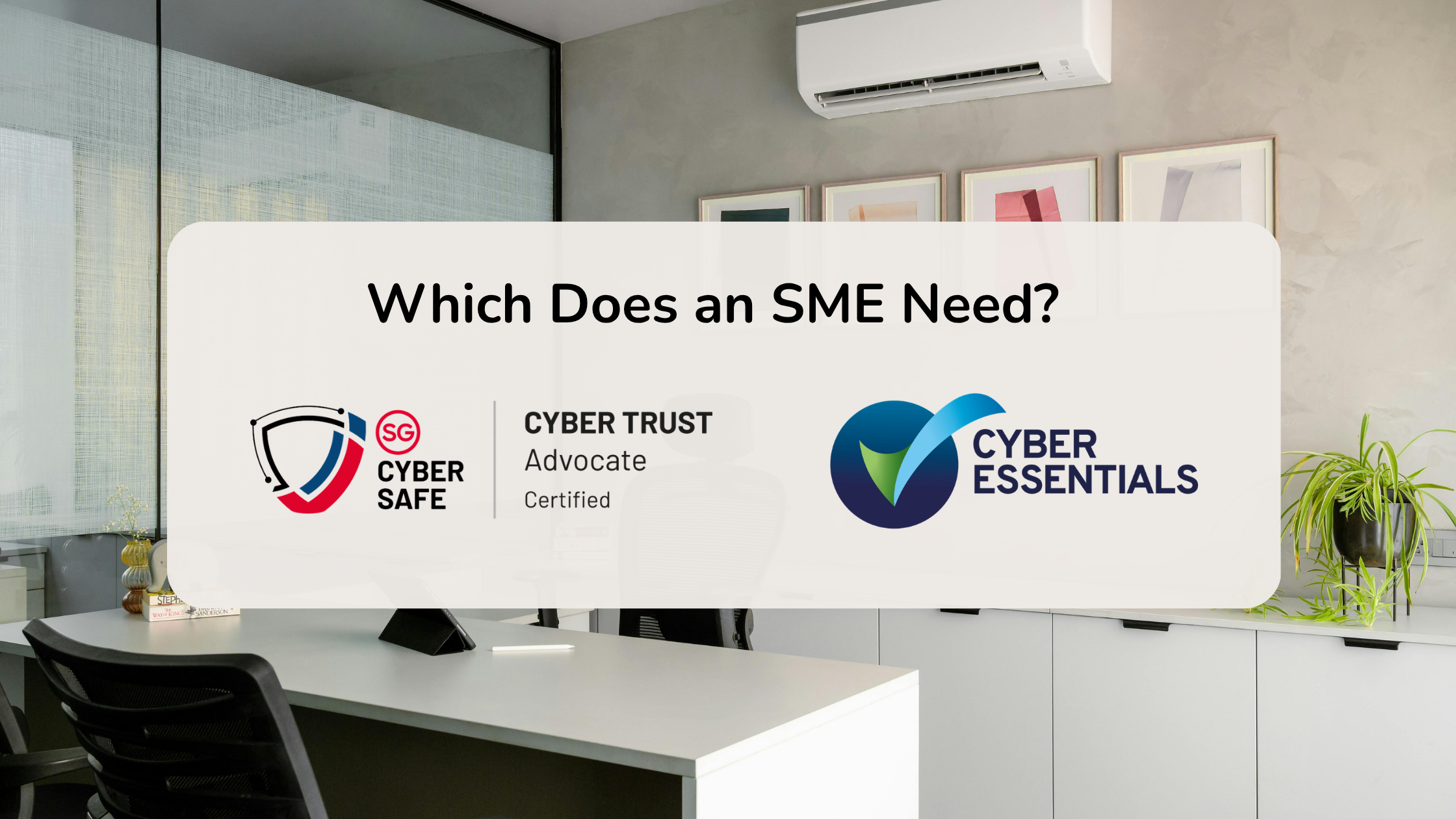
Cyber Essentials
Cyber Essentials is intended primarily to help organisations establish fundamental cybersecurity measures against common cyber threats. For many smaller organisations beginning their cybersecurity journey, it can be the more appropriate starting point.
Certification is valid for two years.
Cyber Trust
Cyber Trust is designed for organisations with more extensive digital operations and higher cybersecurity risk.
It uses a broader risk-based approach and covers more cybersecurity preparedness domains depending on the organisation's risk profile.
Certification is valid for three years, with a yearly audit.
————
A simple way to think about it is:
Cyber Essentials = establish good cyber hygiene.
Cyber Trust = demonstrate more comprehensive, risk-based cybersecurity maturity.
Not every 10-person business needs to jump immediately to the highest Cyber Trust level.
The right approach depends on the organisation's systems, data, customers, contractual obligations and risk exposure.
Cyber Trust Now Has Five Cybersecurity Preparedness Levels
Under the enhanced framework, organisations can fall into one of five cybersecurity preparedness tiers:
Level 1 - Supporter
Level 2 - Practitioner
Level 3 - Promoter
Level 4 - Performer
Level 5 - Advocate
Depending on the tier, organisations may need to address between 10 and 22 cybersecurity domains. This tiered approach is important because cybersecurity should be proportionate to risk.
A small professional-services SME using Microsoft 365 has a different risk profile from a large organisation operating complex infrastructure, AI systems, cloud environments and sensitive databases.
The goal should therefore not be: "How do we get the highest certification?"
The better question is: "What is our actual cybersecurity risk, and what controls should we implement to manage it?"
The 2027 Clinic Problem Is Bigger Than Certification
For healthcare businesses, focusing only on obtaining a cybersecurity badge can miss the larger issue.
Consider a 10-person GP clinic. It may rely on: a Clinic Management System, Windows PCs, Microsoft 365, Wi-Fi, printers and scanners, cloud applications, medical devices, shared folders, third-party vendors, remote IT support, and NEHR connectivity.
Each system introduces dependencies. The clinic might have antivirus installed and still have serious weaknesses.
For example:
Everyone shares an administrator password.
A former employee's account remains active.
Backups exist but have never been tested.
Staff can access systems without MFA.
Windows devices are no longer properly patched.
An IT vendor has permanent remote access.
Nobody knows who should respond to a security incident.
Buying another security product will not necessarily fix these problems.
Cybersecurity readiness requires people, processes, and technology to work together.
Your IT Vendor Is Now Part of Your Cybersecurity Risk
This deserves particular attention for SMEs and clinics using outsourced IT support.
If your IT provider manages your firewall, Microsoft 365 environment, administrator accounts, backups, endpoints, network, remote access, or security tools, that provider may hold privileged access to a significant portion of your organisation.
Vendor management therefore becomes part of cybersecurity.
Healthcare cybersecurity guidance has specifically highlighted the need for organisations using external IT providers to understand the services and security practices those vendors provide, establish responsibilities clearly, and receive relevant vulnerability and security updates.
Before 2027, clinics should be able to answer a simple question: Exactly what is our IT provider responsible for - and what remains our responsibility?
"We call our IT guy when something breaks" is no longer a strong cybersecurity operating model.
A Practical Cybersecurity Readiness Plan for 2026–2027
You do not need to replace your entire IT environment tomorrow. A more practical approach is to work through the risk systematically.
Step 1: Conduct an IT and Cybersecurity Assessment
Start by documenting what actually exists. Review: computers and laptops, Windows versions, servers, firewalls, network equipment, Wi-Fi, Microsoft 365, cloud applications, administrator accounts, employee accounts, endpoint protection, backups, remote-access tools, Clinic Management Systems, medical devices where relevant, and third-party vendor access.
You cannot protect systems you do not know exist.
Step 2: Identify Your Highest-Risk Gaps
Do not immediately purchase new hardware or cybersecurity software. First identify weaknesses.
For example: unsupported Windows systems, missing MFA, shared accounts, excessive administrator privileges, outdated firmware, weak backup processes, unmanaged devices, undocumented vendor access or missing incident-response procedures.
Prioritise the risks that could have the largest business or data impact.
Step 3: Establish Basic Cyber Hygiene
Before pursuing advanced certification, make sure the fundamentals work.
This may include: MFA, endpoint protection, patch management, secure administrator access, reliable backups, tested recovery procedures, email security, appropriate firewall configuration, and employee cybersecurity awareness.
Step 4: Document Policies and Responsibilities
Technical controls alone are not enough. Document who is responsible for: account creation, employee offboarding, administrator privileges, patching, backup checks, vendor access, incident escalation, security reviews, and recovery.
This becomes particularly important when responsibilities are divided between employees, management, software vendors and outsourced IT providers.
Step 5: Build an Incident Response Process
Do not wait for ransomware, account compromise or a data breach before deciding what to do. Your organisation should know:
Who employees contact.
Who investigates the incident.
Who can disable accounts or isolate affected systems.
How evidence and logs are preserved.
Who communicates with management.
For healthcare providers, how HIA reporting requirements will be handled.
Step 6: Decide Whether Cyber Essentials or Cyber Trust Is Appropriate
Once the foundation is stable, assess the appropriate certification route.
For a smaller SME beginning its cybersecurity journey, Cyber Essentials may provide an appropriate starting point.
For organisations with larger digital environments, sensitive data, more complex systems or higher customer expectations, Cyber Trust may be more appropriate.
Government Support Can Reduce the Cost
Singapore businesses should also check available cybersecurity funding rather than assuming the full cost must be absorbed internally. CSA currently provides funding support for eligible Singapore SMEs and non-profit organisations pursuing their first successful Cyber Trust (2025) certification, with the current support period running until 6 February 2028. Support is also available for Cyber Essentials certification.
Healthcare providers have additional support mechanisms. For example, eligible GP clinics may receive support through programmes including:
the NEHR Connect Grant (NCG);
Productivity Solutions Grant (PSG) support for eligible cybersecurity solutions; and
CSA's CISO-as-a-Service support for HIA cybersecurity and data-security readiness.
MOH currently illustrates that a solo GP practice could potentially receive approximately S$20,000 in combined government support, subject to eligibility and the relevant programme conditions.
For GP providers, applications for the NEHR Connect Grant opened on 1 July 2026, with the current application deadline stated as 31 August 2027.
That makes 2026 an ideal time to assess readiness rather than waiting for the September 2027 implementation date.
Why 2026 Is the Right Time to Prepare for 2027
Cybersecurity improvements often take longer than expected.
A gap assessment may uncover: outdated computers, unsupported operating systems, poorly configured networks, missing documentation, untested backups, unmanaged administrator accounts, legacy applications, insecure vendor access, or unclear internal responsibilities.
Some problems can be fixed immediately. Others require budgeting, hardware replacement, migration, policy development or coordination with software vendors.
Starting now gives your organisation time to prioritise improvements instead of making rushed purchases immediately before a compliance deadline.
Frequently Asked Questions
-
No. There is currently no blanket requirement for every Singapore SME to obtain Cyber Trust certification by 2027. Specific requirements apply to certain regulated organisations, including CII owners and specified cybersecurity service providers.
However, SMEs may pursue Cyber Trust voluntarily to demonstrate stronger cybersecurity maturity to customers, partners and stakeholders.
-
CSA states that Cyber Trust (2022) is no longer in use from February 2026. Organisations pursuing Cyber Trust certification should refer to the enhanced Cyber Trust (2025) framework, published as SS 712:2025.
-
SS 712:2025 is the Singapore Standard for tiered cybersecurity standards for organisations. The enhanced Cyber Trust Mark is based on this standard.
-
Cyber Essentials focuses on fundamental cybersecurity controls that help organisations protect themselves against common cyber threats.
Cyber Trust is intended for organisations with more extensive digital operations and higher cybersecurity risks and uses a more comprehensive risk-based approach.
-
Cyber Trust certification itself is not currently a blanket requirement for every Singapore clinic.
Clinics should instead pay close attention to the cybersecurity and data security obligations being introduced under the Health Information Act.
-
Under the current implementation schedule, Outpatient Medical Service (GP) providers are in the first implementation batch and must begin NEHR contribution and implement the applicable cybersecurity and data security measures by September 2027.
-
MOH has published the Cybersecurity and Data Security (CS/DS) Essentials for Healthcare Providers, which set out the relevant cybersecurity and data-security requirements.
-
Under HIA, healthcare providers have incident and data-breach notification obligations. MOH states that an initial report of a confirmed reportable cybersecurity incident or data breach must be provided within two hours, followed by a detailed report within 14 days.
-
It depends on its risk profile.
Smaller businesses that are still establishing basic cybersecurity controls may begin with Cyber Essentials. Organisations with more extensive digital operations, sensitive data or higher cyber risk may be better suited to Cyber Trust.
A cybersecurity assessment should normally come before choosing a certification level.
Prepare for 2027 Before It Becomes Urgent
Singapore's cybersecurity landscape is moving from "install security software" toward demonstrable cyber resilience. Cyber Trust (2025) raises the benchmark through SS 712:2025.
The Health Information Act introduces another layer of responsibility for healthcare providers, with GP clinics among the first groups facing the September 2027 implementation timeline. The key is not to panic and purchase every cybersecurity product available. Start by understanding your current environment.
Assess → Identify gaps → Prioritise → Remediate → Document → Test → Certify where appropriate.
For a small clinic or SME without an internal IT department, having a structured IT partner can make that process significantly easier.
Need to Know If Your Business Is Ready for 2027?
Advance IT helps Singapore SMEs and healthcare organisations assess and strengthen their IT infrastructure and cybersecurity readiness.
Our team can help review areas such as:
current IT infrastructure and security gaps;
endpoint and Windows security;
Microsoft 365 security;
MFA and account access;
network and firewall configuration;
patch management;
backup and recovery;
vendor and remote-access controls;
cybersecurity documentation;
ongoing IT maintenance; and
readiness planning for Cyber Essentials, Cyber Trust and applicable healthcare cybersecurity requirements.
Instead of waiting until a compliance deadline exposes gaps in your environment, start with an assessment of where you are today.
Book a 30-minute consultation with Advance IT to discuss your current environment and build a practical cybersecurity roadmap for 2027.





Singapore's Cyber Trust Mark has changed. Learn what SS 712:2025 means for SMEs, the September 2027 HIA deadline for GP clinics, Cyber Essentials vs Cyber Trust, and how to prepare.