

Is Your Clinic Ready for the Health Information Act? A Plain-English Guide for Private Practices in Singapore

If you run a private clinic in Singapore, the Health Information Act (HIA) is something you should be preparing for now - not in September 2027.
The Health Information Act was enacted on 3 February 2026. It creates a legal framework governing how health information is contributed, accessed, shared and protected across Singapore's healthcare system.
For private practices, two changes are particularly important:
Licensed healthcare providers will progressively need to contribute required health information to the National Electronic Health Record (NEHR).
Healthcare providers must implement mandatory Cybersecurity and Data Security (CS/DS) measures to protect health information.
For GP / Outpatient Medical Service providers, the current implementation deadline is September 2027.
But HIA readiness is not simply a matter of connecting your Clinic Management System to NEHR.
Your computers, staff accounts, passwords, backups, network, cybersecurity, IT vendors, policies and incident-response procedures can all form part of the bigger picture.
Here is what private practices need to know - in plain English.
What Is the Health Information Act in Singapore?
The Health Information Act, or HIA, is Singapore legislation governing the contribution, access, sharing and protection of health information.
One of its major objectives is to make important patient information available across healthcare settings through the National Electronic Health Record (NEHR).
Imagine a patient who visits: GP → Specialist → Hospital → Another Clinic
Without connected health information, relevant records may remain fragmented across different healthcare providers. NEHR is intended to provide authorised healthcare professionals with access to key patient information to support safer and more coordinated care.
But connecting more healthcare providers also means more responsibility for protecting that information.
That is why HIA covers not only health information sharing, but also cybersecurity and data security.
Quick Answer: What Does HIA Mean for a Private Clinic?
For many private clinics, HIA readiness can be understood as three connected responsibilities:
1. Contribute required health information to NEHR
Licensed healthcare providers will progressively need to contribute specified health information generated during patient care.
2. Protect health information
Clinics need to implement the applicable Cybersecurity and Data Security measures required under HIA.
3. Prepare for cybersecurity incidents and data breaches
Clinics need processes for identifying, assessing, managing, and, where required, reporting notifiable cybersecurity incidents and data breaches.
In other words: HIA readiness = NEHR + Cybersecurity + Data Security + People + Processes.
Simply purchasing a new Clinic Management System does not automatically solve all five areas.
When Does My Clinic Need to Comply With HIA?
MOH is implementing HIA requirements in batches.
The current timeline is:

There is an important detail for practices offering both general and specialist medical services.
According to MOH's implementation guidance, Outpatient Medical Service clinics that indicate both General Medical and Specialist Medical services in the Healthcare Application and Licensing Portal (HALP) fall under the Batch 2 timeline for NEHR contribution, September 2028.
So do not assume your deadline purely from the word "clinic."
Confirm your service type and applicable implementation timeline.
What Information Will Clinics Need to Send to NEHR?
One common concern is: "Does this mean every detail in our patient's medical record goes into NEHR?"
No. The required information depends on your licence type. For Outpatient Medical Services, information that may need to be contributed includes: visit events; adverse drug event history; prescribed or dispensed medications; medication lists; vaccines administered; cardiac reports such as ECGs; surgical procedure notes; visit diagnoses; reasons for visit or patient problem lists; and referral memoranda.
MOH's current guidance also makes two useful distinctions.
You do not need to upload all historical records - The contribution requirement applies prospectively after your system is connected to NEHR. Clinics are not expected to upload their entire historical patient database simply because they join NEHR.
Detailed consultation and progress notes are not required for NEHR contribution - The requirement concerns specified health-information components rather than automatically sending every note your doctors have ever written.
That distinction can make the transition less intimidating for smaller practices.
Do Private Clinics Need a New Clinic Management System?
Not necessarily. This is one of the first things clinics should check before spending money.
Your current Health Information Management System (HIMS), which may include your Clinic Management System, may already be capable of being upgraded or configured to meet the requirements.
Alternatively, you may need to adopt an HIA-compliant system. MOH states that HIMS seeking formal HIA compliance need to satisfy NEHR connectivity requirements as well as relevant governance and security requirements.
These include areas such as: system integration; data integration; national coding standards; cybersecurity; and data portability.
So before replacing your clinic software, ask your HIMS/CMS vendor: "Will our current system be HIA-compliant?"
"Will it support NEHR contribution for our licence type?" "What upgrades are required?"
"When will they be completed?" "What do we need to do on our side?"
The final question is particularly important. Because your HIMS vendor does not necessarily manage your entire clinic IT environment.
HIMS Compliance Is Not the Same as Clinic IT Compliance
This distinction can save clinics a lot of confusion. Imagine your HIMS vendor confirms: "Our system will be HIA-compliant."
Good. But what about the computer running it? What about Windows? Your Wi-Fi? Your firewall? Administrator accounts? Remote access? Backups? Endpoint protection? Employee access? Cybersecurity policies?
These may sit outside your HIMS vendor's responsibility. A simplified way to think about it is:
Your HIMS / CMS vendor may manage
clinic software; patient-record functionality; HIMS security requirements; NEHR integration; system integration; data contribution; and application updates.
Your clinic or IT provider may manage
computers; Windows; Microsoft 365; networks; Wi-Fi; firewall; user accounts; administrator accounts; endpoint protection; backups; patching; remote access; monitoring; and general cybersecurity.
There will be areas where these responsibilities overlap. That is why your clinic's HIA preparation should involve both your HIMS vendor and whoever manages your IT infrastructure.
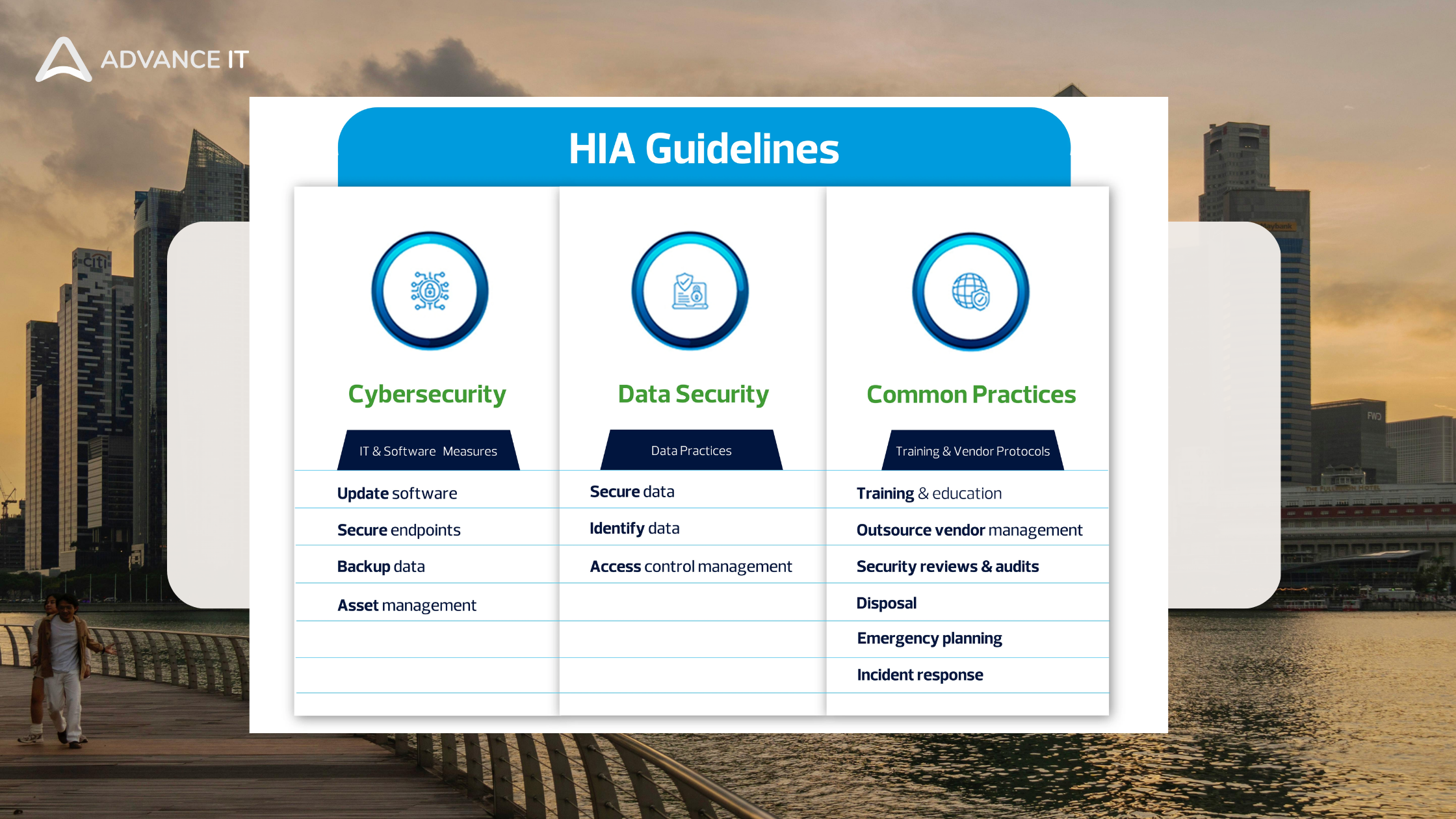
What Are the HIA Cybersecurity and Data Security Requirements?
MOH has published Cybersecurity and Data Security Essentials for Healthcare Providers.
These requirements were developed in consultation with the Cyber Security Agency of Singapore (CSA), Infocomm Media Development Authority (IMDA) and Personal Data Protection Commission (PDPC). They are intended to establish practical safeguards around how health information is stored, accessed, used and shared.
For a clinic owner, you do not need to become a cybersecurity engineer. But you should understand the major areas your clinic needs to control.
-
Start with the basics: What technology does your clinic actually use?
You should be able to identify things such as: desktop computers, laptops/servers, network equipment, firewalls, Wi-Fi access points, printers and scanners, HIMS/CMS, Microsoft 365, cloud applications, endpoint protection, backup systems, remote-access software, and relevant medical devices.
This sounds simple.
In practice, many small businesses accumulate technology over years without maintaining a complete inventory.
You cannot properly secure an asset you do not know exists.
-
Not every employee needs access to everything.
A clinic should know: Who has access? What can they access? Why do they need that access? Do they still need it?
This becomes particularly important when employees:
Join
Change roles
Leave
Work remotely
Receive administrator privileges.
Shared accounts can also make accountability difficult.
If several employees use the same login, it becomes harder to determine who accessed or changed information. Access should therefore be appropriate to each person's role.
-
A stolen password can give an attacker a direct route into a business system.
Clinics should review:
Password practices
Administrator accounts
Multi-Factor Authentication (MFA)
Inactive accounts
Former employee accounts
Shared accounts
Remote-access credentials.
Microsoft 365 deserves particular attention because compromised email accounts can be used for phishing, impersonation and further access into an organisation.
-
Software vulnerabilities are discovered constantly. If your clinic uses outdated or unsupported software, attackers may exploit known weaknesses.
Review:
Windows versions;
operating-system updates;
application updates;
firewall firmware;
network equipment;
browsers;
endpoint security software; and
HIMS/CMS updates.
A computer can appear to work perfectly while still presenting a cybersecurity risk.
"Still working" and "secure" are not the same thing.
-
Healthcare information can be particularly sensitive.
Clinics should have appropriate protection against threats such as:
malicious software;
ransomware;
phishing;
compromised email accounts; and
infected endpoints.
But cybersecurity is not simply:
"We installed antivirus, so we're safe."
Endpoint security needs to work together with access controls, patching, backups, network security and employee awareness.
-
Ask your clinic: “When was our last successful backup?”
Then ask a better question: “When was the last time we successfully restored something from that backup?”
Those are not the same thing.
A backup that cannot be restored when you need it is not much of a backup.
Your clinic should understand:
what is backed up;
how frequently;
where backups are stored;
who monitors backup failures;
how backups are protected; and
how restoration works.
Do not wait for an incident to discover that your backup process was incomplete.
-
Many clinics rely on external vendors. Your HIMS vendor might connect remotely. Your IT provider might connect remotely.
Another software vendor might have remote access. That means third-party access becomes part of your security environment.
Ask:
Which vendors can remotely access our systems?
What remote-access tools are installed?
Are those accounts still required?
How are they authenticated?
Do vendors have permanent access?
Who approves access?
Can access be removed quickly?
"Someone installed TeamViewer years ago" should not be your remote-access policy.
-
Imagine this happens tomorrow morning: A receptionist clicks a suspicious email. Shortly afterwards, unusual login activity appears.
What happens next? Who does the receptionist call? Who disables the account?
Who investigates the computer? Who determines whether health information may have been exposed?
Who contacts your HIMS vendor? Who documents what happened?
Who decides whether the incident is reportable?
This is why incident response cannot be invented during the incident.
Under HIA, healthcare providers must assess cybersecurity incidents and data breaches to determine whether they are notifiable. Where an incident or breach is assessed as notifiable, the current framework requires an initial notification to MOH within two hours of that assessment, followed by a detailed report within 14 days of the initial notification.
For notifiable data breaches involving health information that are likely to result in significant harm, affected individuals must also be notified.
Importantly, MOH states that these mandatory reporting requirements have not yet taken effect and that further communication will be provided on when mandatory reporting begins.
So clinics should prepare the process now rather than waiting for an incident to occur.
"We're Already on NEHR." Are We Ready?
Not necessarily. Being connected to NEHR solves one part of the picture. HIA also introduces cybersecurity and data-security responsibilities. A clinic might already contribute to NEHR but still have issues such as: unsupported computers, weak administrator passwords, shared accounts, inadequate MFA, untested backups, unmanaged remote access, outdated firewalls, missing IT documentation, or no incident-response procedure.
NEHR connectivity and cybersecurity readiness should therefore be assessed separately.
"We Already Follow PDPA." Is That Enough?
HIA does not exist in isolation.
Healthcare providers already have obligations relating to personal information under Singapore's Personal Data Protection Act (PDPA) and sector-specific requirements such as the Healthcare Services Act (HCSA). HIA builds on the existing environment by introducing and consolidating requirements specifically relating to health information, including cybersecurity and data-security standards.
So the right question is not: "Do we follow PDPA or HIA?"
Your clinic may have responsibilities under both, along with other applicable healthcare requirements.
Does a Small GP Clinic Really Need All This?
Yes, but that does not mean a 5-person clinic needs the same IT infrastructure as a hospital.
This is an important distinction. The objective is not to turn every private practice into an enterprise data centre. The goal is to establish reasonable baseline safeguards appropriate for protecting health information.
For a small clinic, the practical priorities might be much simpler: Know your devices → Secure your accounts → Enable appropriate MFA → Keep computers patched → Protect endpoints → Maintain reliable backups → Control vendor access → Document responsibilities → Train employees → Know what to do when an incident occurs.
Small clinics may have fewer systems. But fewer systems does not mean no cybersecurity risk.
A Practical HIA Readiness Checklist for Private Clinics
If you are unsure where to begin, start here.
-
☐ Confirm your HIA implementation timeline.
☐ Ask your HIMS/CMS vendor whether your current system will meet HIA requirements.
☐ Confirm how your system will connect and contribute required information to NEHR.
☐ Understand which health-information components your clinic must contribute.
☐ Confirm the responsibilities of your HIMS vendor versus your clinic.
-
☐ Create an inventory of computers and other relevant IT assets.
☐ Identify Windows versions.
☐ Identify outdated or unsupported systems.
☐ Document network and firewall equipment.
☐ Identify software and remote-access tools installed across clinic devices.
-
☐ Review every active user account.
☐ Remove accounts belonging to former employees.
☐ Review administrator privileges.
☐ Avoid unnecessary shared accounts.
☐ Implement appropriate MFA.
☐ Document employee onboarding and offboarding.
-
☐ Confirm endpoint protection is active and monitored.
☐ Ensure operating systems and applications are patched.
☐ Review firewall configuration.
☐ Secure remote access.
☐ Review third-party vendor access.
☐ Assess email and Microsoft 365 security.
-
☐ Identify critical data that needs protection.
☐ Confirm backups are running successfully.
☐ Protect backup access.
☐ Test restoration.
☐ Document what happens if a critical system becomes unavailable.
-
☐ Assign responsibility for cybersecurity.
☐ Document basic IT and cybersecurity procedures.
☐ Train staff on phishing and cybersecurity awareness.
☐ Establish procedures for handling employee departures.
☐ Create an incident-response process.
-
☐ Know who employees should contact.
☐ Know who investigates an incident.
☐ Know how affected systems can be isolated.
☐ Know how accounts can be disabled.
☐ Know who coordinates with external IT/HIMS vendors.
☐ Understand the HIA incident-assessment and reporting process.
If you cannot confidently tick many of these boxes, that does not mean your clinic has failed. It means you have identified where to start.
Don't Wait Until September 2027 to Start
There is a practical reason to begin early.
An IT assessment might discover: computers approaching end of support, old network equipment, weak Wi-Fi architecture, missing MFA, backup problems, outdated firewall firmware, unmanaged user accounts, legacy software, undocumented vendor access, or unclear responsibilities between your clinic, HIMS vendor and IT provider.
Some of these issues can be fixed quickly.
Others require: budgeting, hardware replacement, software migration, coordination with vendors, policy changes, employee training, or testing.
Trying to resolve everything immediately before the deadline creates unnecessary operational pressure.
Is There Government Support for HIA Readiness?
Yes. MOH has introduced implementation support to help eligible healthcare providers adopt HIA-compliant systems and strengthen cybersecurity and data security.
One important programme is the NEHR Connect Grant (NCG). The grant supports eligible healthcare providers in upgrading existing HIMS or adopting HIA-compliant HIMS to support secure contribution of health information to NEHR.
Eligible GP providers can already apply. Healthcare providers can also access support for implementing Cybersecurity and Data Security measures, including qualified service providers referenced through CSA.
Do not assume that every upgrade needs to be funded entirely by the clinic. Check your eligibility and the latest available support before committing to major expenditure.
What Should You Ask Your Current IT Provider?
Send your IT provider these questions:
1. Have you reviewed the latest HIA Cybersecurity and Data Security Essentials?
2. Which of our existing systems are covered by you?
3. Can you provide an inventory of our current IT environment?
4. Which computers are outdated or approaching end of support?
5. Is MFA appropriately implemented?
6. Are our administrator accounts properly controlled?
7. How are our systems patched?
8. How are our backups monitored and tested?
9. Who currently has remote access to our network and computers?
10. Do we have an incident-response process?
11. Can you coordinate directly with our HIMS/CMS provider?
12. What gaps should we prioritise before our HIA implementation date?
If the answer to most of these questions is: "We'll check when something happens." Your clinic may still be operating under a reactive IT model.
Frequently Asked Questions About HIA for Private Clinics
-
The Health Information Act is Singapore legislation governing how health information is contributed, accessed, shared and protected. It was enacted on 3 February 2026 and introduces requirements including NEHR contribution and cybersecurity and data-security measures for regulated healthcare entities.
-
Licensed healthcare providers are within the HIA framework. The exact implementation timeline and requirements depend on the healthcare service type.
-
Under the current implementation timeline, Outpatient Medical Service (GP) providers are in Batch 1 and need to begin required NEHR contribution and implement applicable Cybersecurity and Data Security measures by September 2027.
-
Outpatient Medical Service (Specialist) providers are currently in Batch 2, with implementation by September 2028.
Clinics licensed for multiple service types should verify the timeline applicable to their specific licence configuration.
-
Licensed healthcare providers are within the HIA framework. The exact implementation timeline and requirements depend on the healthcare service type.
-
No. MOH's current guidance states that contribution applies prospectively after the system is connected to NEHR. Historical records do not need to be uploaded simply as part of onboarding.
-
MOH's current guidance states that detailed consultation and progress notes are not required to be contributed to NEHR.
-
Not necessarily.
An HIA-compliant HIMS addresses important system and NEHR requirements, but the clinic still needs to manage its broader cybersecurity and data-security responsibilities, including areas such as devices, accounts, access, patching, backups, policies and staff practices.
-
MOH states that engaging professional CS/DS services is optional.
Whether you need external IT support depends on your clinic's capabilities and environment.
A clinic without internal IT expertise may benefit from professional assistance with infrastructure assessment, cybersecurity implementation, documentation, ongoing maintenance and coordination with its HIMS vendor.
-
Start by confirming your implementation timeline, speaking with your HIMS vendor and assessing your current IT and cybersecurity environment.
Do not start by purchasing random cybersecurity products.
Know what you have → identify gaps → prioritise risk → implement controls → document → test.
Your HIMS Vendor Handles the System. Who Is Looking After Everything Around It?
This may become one of the most important HIA questions for private practices. Your clinic might have an HIA-ready HIMS. But someone still needs to look after:
The computer it runs on; the account used to access it; the network connecting it; the firewall protecting the clinic; the backup protecting your information; the remote access used by vendors; and the employees using all of it every day.
That is where managed IT and cybersecurity support fit into the HIA readiness journey.
Preparing Your Clinic for HIA: How Advance IT Can Help
Advance IT supports Singapore healthcare organisations with the IT infrastructure surrounding their day-to-day clinical systems. Rather than starting with a list of products to purchase, we can start by reviewing what your clinic already has.
An assessment may cover: desktops and laptops, Windows environments, Microsoft 365, network infrastructure, Wi-Fi, firewall, user and administrator accounts, MFA, endpoint security, patch management, backup and recovery, remote access, third-party vendor access, IT documentation; and coordination points with your HIMS/CMS provider.
From there, the objective is simple:
Identify what is working.
Identify what presents a risk.
Identify what needs attention before your HIA implementation deadline.
For clinics without an internal IT department, Advance IT can also provide ongoing managed IT support so that cybersecurity and infrastructure maintenance do not become a once-a-year compliance exercise.
Start With an HIA IT Readiness Review
You do not need to replace every computer. You do not need to buy every cybersecurity product.
And you should not wait until September 2027 to find out what needs fixing. Start with your current environment. Find the gaps. Build a practical roadmap.
Book a 30-Minute Clinic IT Consultation
Talk to Advance IT about your clinic's current IT environment and the technical areas you should review as you prepare for HIA.
Advance IT Services Pte Ltd
With over 15 years of experience and a strong focus on IT support and Managed IT, we’re proud that 99.5% of our customers stay with us long-term.
‣ Website: https://www.advanceit.sg/
‣ Address: 8 Burn Road, #11-11 Trivex Singapore 369977
‣ Email us at: contact@advanceit.sg
‣ Call our team: +65 6592 8458
This article provides general information about IT and cybersecurity readiness and should not be treated as legal or regulatory advice. Clinics should refer to the latest MOH HIA guidance for their specific obligations.







Is your Singapore clinic ready for the Health Information Act? Learn the 2027 HIA deadline, NEHR requirements, cybersecurity rules and practical steps private clinics should take now.