

Which Cyber Trust Mark Tier Fits Your Clinic? Supporter to Advocate Compared
Which Cyber Trust Mark tier should a Singapore clinic aim for? The answer is not determined by clinic size alone.
Under CSA's Cyber Trust framework, organisations select an appropriate Cybersecurity Preparedness tier based on their risk profile. There are five tiers: Supporter → Practitioner → Promoter → Performer → Advocate
The framework progresses from 10 cybersecurity preparedness domains at Supporter to all 22 domains at Advocate. For a clinic, factors such as the amount and sensitivity of health information handled, number of locations, reliance on digital systems, cloud usage, third-party access and operational impact of a cyber incident can all affect the level of cybersecurity preparedness appropriate for the organisation.
So a solo GP should not automatically choose Supporter, and a specialist group should not automatically choose Performer.
Quick answer: Cyber Trust has five cybersecurity preparedness tiers: Supporter, Practitioner, Promoter, Performer and Advocate. The right tier depends on your organisation's cybersecurity risk profile and digital maturity, not simply its number of employees or clinics.
Here is how to think about the five tiers, followed by a practical tier picker for solo GPs, group practices and multi-location specialist clinics in Singapore.
What Are the 5 Cyber Trust Mark Tiers?
Cyber Trust is designed for organisations with more extensive digitalised operations and higher cybersecurity risk profiles. Unlike a one-size-fits-all security checklist, it uses a risk-based approach: the organisation determines its risk profile and then identifies the cybersecurity preparedness areas appropriate for that risk.
CSA's framework contains five tiers:
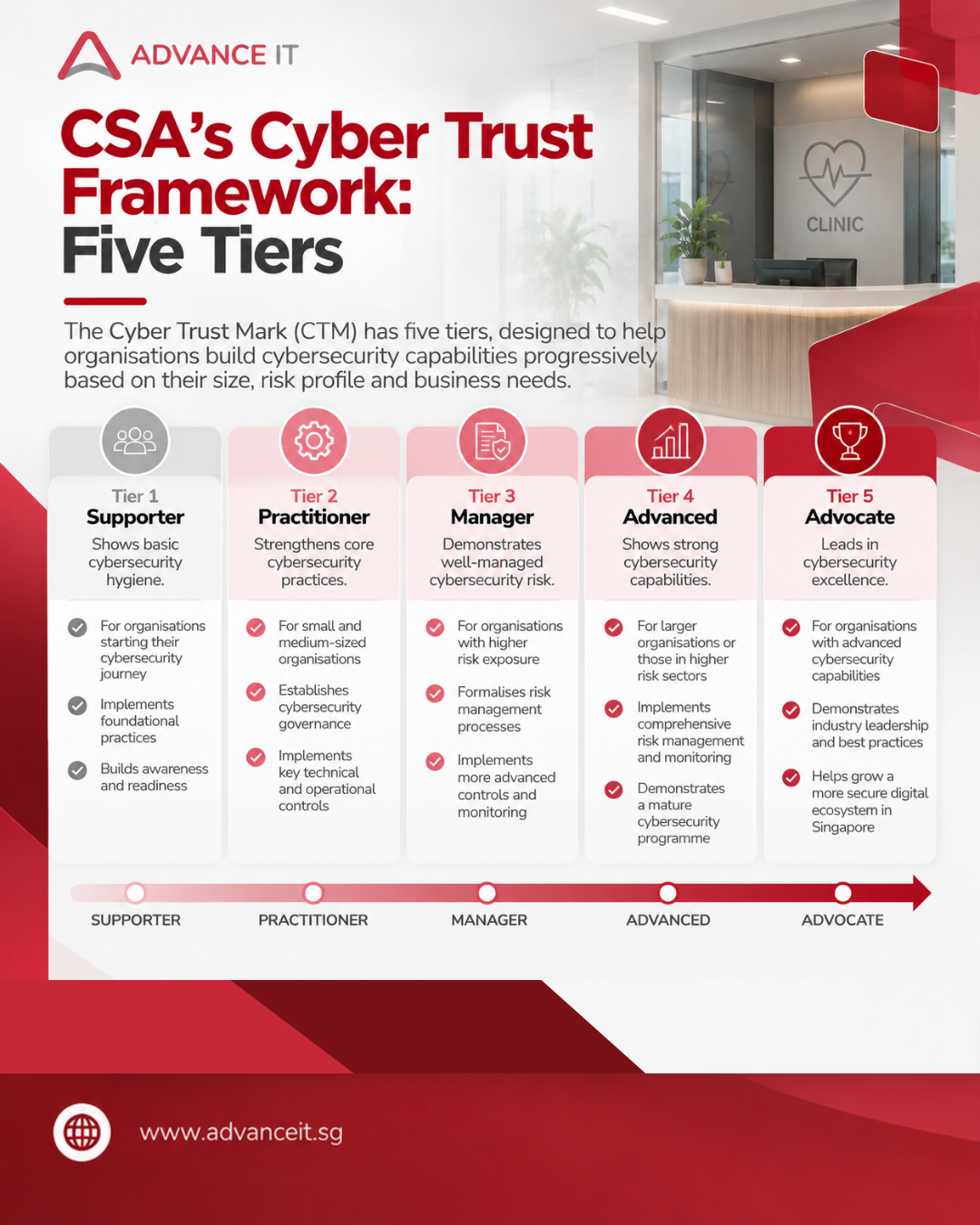
These profiles are indicative, not automatic classifications.
Two clinics of exactly the same size can have different cybersecurity risks and therefore require different preparedness tiers.
-
Supporter is the first Cyber Trust preparedness tier and covers 10 cybersecurity domains.
CSA's indicative profile associates it with small and some micro organisations at a starter level of digital maturity, including some digital-native startups.
For a healthcare business, however, size should not be considered in isolation.
A small clinic may still:
process sensitive health information;
rely heavily on a HIMS;
access NEHR;
use Microsoft 365;
store information in cloud systems;
allow remote access;
rely on multiple third-party vendors; and
face significant disruption if its systems become unavailable.
That means: Small clinic ≠ automatically Supporter.
A solo GP with a relatively simple environment might find its risk assessment points toward a lower preparedness tier, but this should be established through the Cyber Trust risk-assessment process rather than assumed from headcount.
-
Practitioner expands the Cyber Trust scope to 13 cybersecurity domains.
CSA's indicative profile associates Practitioner with small and medium organisations at a starter level of digital maturity. For clinics, this could become relevant as the environment becomes more complex. For example, imagine a medical practice that has:
several doctors and employees;
more endpoints;
Microsoft 365;
cloud applications;
a HIMS;
multiple types of health information;
several external IT or software vendors; and
greater dependence on technology for everyday operations.
The cybersecurity risk is no longer defined simply by whether the organisation is technically an SME. The number of systems, connections, users and dependencies matters too. For a growing clinic, Practitioner may therefore be worth evaluating rather than automatically choosing the lowest tier.
The final tier should still come from the CSA risk-assessment framework.
-
Promoter covers 16 cybersecurity preparedness domains. CSA's indicative organisation profile moves toward medium and some larger organisations with a more developed level of digital maturity. For a healthcare provider, think about what happens when a single clinic becomes a group practice. Instead of one location, the organisation may now have:
multiple clinics;
more doctors and employees;
larger numbers of endpoints;
centralised Microsoft 365 accounts;
shared systems;
more vendors;
remote administration;
cross-location access;
more complex networks;
greater volumes of health information; and
a larger operational impact if central IT systems fail.
This changes the risk picture. A group practice should therefore assess whether a broader Cyber Trust preparedness tier is appropriate rather than simply applying the same controls that worked when the business had one location.
-
Performer covers 19 cybersecurity preparedness domains. CSA's indicative profile associates this tier with organisations at a more advanced level of digital maturity, including large and some medium organisations.
For healthcare, Performer may become worth evaluating where the organisation operates a more sophisticated digital environment.
For example: A multi-location specialist healthcare group may operate centralised infrastructure, numerous cloud platforms, interconnected clinics, larger teams, more complex access permissions and multiple technology vendors. It may also face substantially greater consequences from:
ransomware;
credential compromise;
system outages;
unauthorised access;
third-party compromise; or
loss of availability across multiple clinics.
The appropriate tier depends on the actual risk assessment, but organisations with this level of complexity should not assume that a lower tier is sufficient simply because they remain classified as an SME.
-
Advocate is the highest Cyber Trust preparedness tier and covers all 22 cybersecurity domains.
CSA's indicative profile includes organisations with leading digital maturity, larger organisations and organisations operating in or providing services to regulated sectors. It represents the broadest cybersecurity preparedness scope within the Cyber Trust framework.
For a healthcare organisation, Advocate may be relevant where there is a combination of factors such as:
extensive digital operations;
highly interconnected systems;
large-scale handling of sensitive information;
significant reliance on cloud infrastructure;
sophisticated technology environments;
high business impact from system disruption;
extensive third-party dependencies; and
higher regulatory or stakeholder expectations.
But “healthcare is regulated” does not mean every clinic should automatically choose Advocate. The purpose of Cyber Trust's risk-based model is to match cybersecurity preparedness to the organisation's actual exposure and risk profile.
Cyber Trust Tier Picker for Singapore Clinics
If you want a simple starting point, use this as a discussion guide, not an official CSA tier determination.
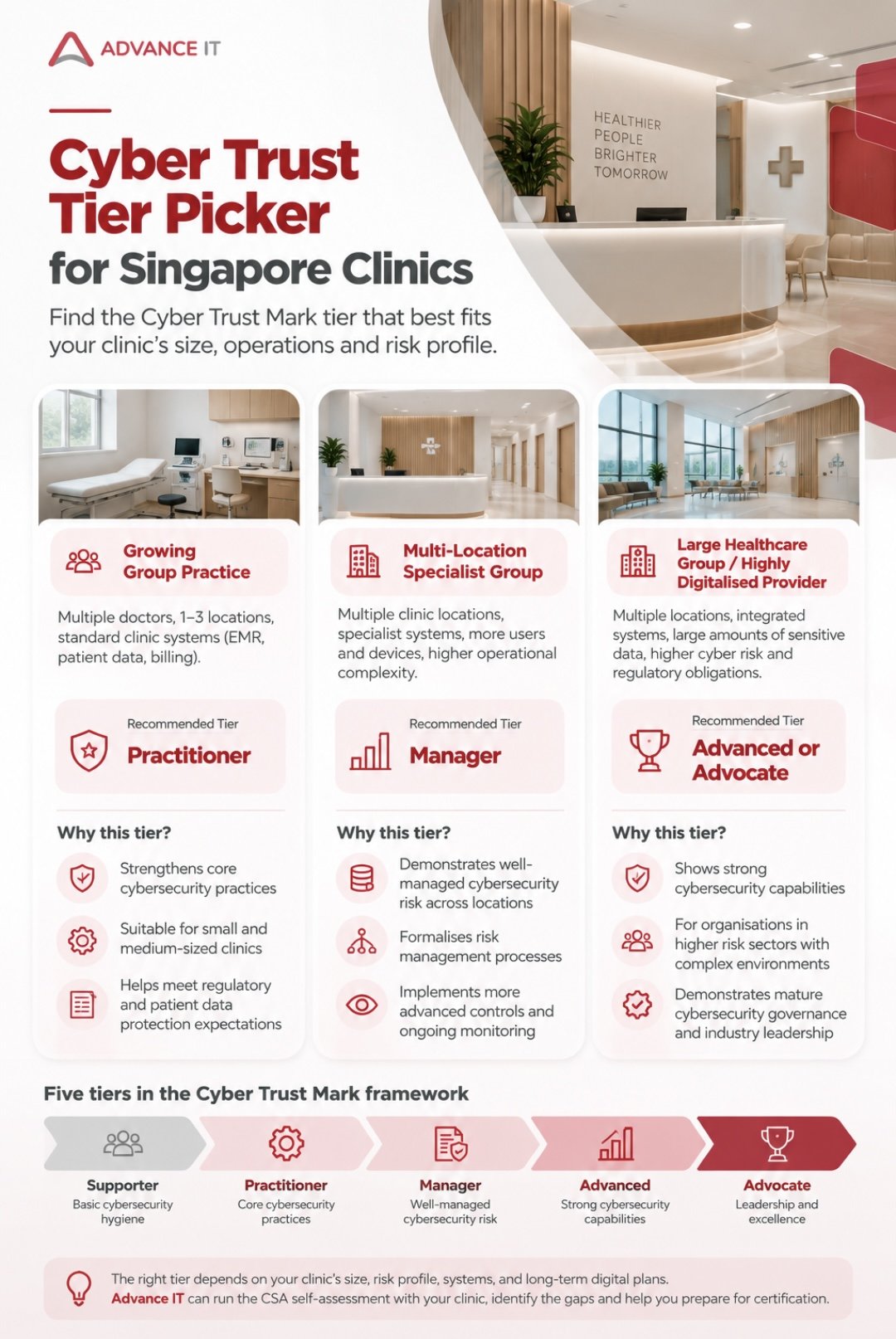
Which Cyber Trust Mark tier should a Singapore clinic aim for
Advance IT can assess your clinic’s current IT and cybersecurity environment, run the CSA self-assessment with your team, identify the gaps that could hold you back, and help implement the required improvements. We then help you get audit-ready before you proceed to the independent CSA-appointed certification body.
Whether you operate one clinic, a growing group practice or multiple specialist locations, the goal is to know what needs fixing before the audit — and build a practical cybersecurity roadmap that works around your clinical operations.
Talk to Advance IT about your clinic’s Cyber Trust readiness and find out which tier makes sense for your environment.
Which Tier Should Your Clinic Aim For?
Do not ask: “What is the lowest tier we can get?”
Ask: “What tier reflects the cybersecurity risk we actually need to manage?”
Cyber Trust is intentionally risk-based. A higher tier is not automatically “better” for every clinic. If your organisation's risk profile points to Practitioner, implementing Advocate-level scope purely for the sake of choosing the highest tier may create unnecessary cost and administrative work. At the same time, choosing a lower target simply because it appears easier can leave important risks outside your cybersecurity programme. The goal is proportionate cybersecurity.
Clinic Size Is Not the Same as Cyber Risk
Consider two specialist clinics with 15 employees each.
Clinic A: It operates from one location. Its technology environment is relatively straightforward, access is tightly controlled and the clinic uses a limited number of managed systems.
Clinic B: It also has 15 employees. But it operates multiple cloud applications, gives external vendors remote access, has staff working across locations, relies heavily on interconnected digital systems and uses AI-enabled applications. Same headcount. Very different risk profile.
Their appropriate Cyber Trust preparedness tiers may therefore be different.
—> The appropriate Cyber Trust tier is determined by an organisation's cybersecurity risk profile and digital maturity, not simply by employee count. Two clinics of the same size may require different preparedness tiers because their systems, data exposure, cloud usage, third-party dependencies and operational risks differ.
What About HIA? Does It Determine Your Cyber Trust Tier?
No. The Health Information Act (HIA) and Cyber Trust certification should not be treated as the same requirement. Under HIA, regulated healthcare entities must comply with the applicable Cybersecurity and Data Security (CS/DS) Essentials. MOH states that these controls apply to HIA-regulated entities and are intended to protect health information during its storage, access, use, and sharing.
Cyber Trust, meanwhile, is a separate CSA cybersecurity certification framework using a risk-based approach.
So:
HIA → regulatory cybersecurity and data-security requirements
Cyber Trust → risk-based cybersecurity certification
They can complement each other, but one should not be used as shorthand for the other. For a clinic, the first question may therefore be: “What do we need for HIA?”
Then: “Do we also have a business or cybersecurity reason to pursue Cyber Trust, and if so, which tier fits our risk profile?”
Should a Small Clinic Choose Cyber Essentials Instead?
Possibly. This is an important question because not every small clinic needs to jump directly into Cyber Trust. CSA positions Cyber Essentials toward smaller organisations seeking to establish foundational cybersecurity measures.
Cyber Trust is positioned toward organisations with more extensive digital operations and higher cybersecurity risk profiles that need a more comprehensive, risk-based approach.
For a small independent clinic, the logical progression may therefore be: HIA CS/DS requirements → establish strong cyber hygiene → Cyber Essentials where appropriate → evaluate Cyber Trust as the organisation's digital operations and risk grow.
That is often more sensible than pursuing a higher certification purely for the badge.
How Advance IT Helps You Choose the Right Tier
You should not have to select a Cyber Trust tier based on a marketing table. The better starting point is your actual environment. Advance IT can work through the CSA self-assessment and risk-assessment process with your clinic to understand:
business operations;
systems and applications;
endpoints;
Microsoft 365;
cloud usage;
health information exposure;
network infrastructure;
user and administrator access;
third-party dependencies;
backup and recovery;
cybersecurity controls; and
operational impact if systems become unavailable.
From there, the objective is to identify the appropriate scope and the gaps between your current environment and the target preparedness tier. Then comes remediation. Advance IT runs the CSA self-assessment with your clinic, fixes the gaps it finds, then hands you to the certification body audit-ready.
A CSA-appointed certification body conducts the independent certification assessment. Advance IT does not issue the Cyber Trust Mark or determine the outcome of the independent certification.
What Happens After You Pick a Tier?
Selecting the target is only the beginning. The practical process looks more like this:
1. Understand your risk profile: Determine the appropriate Cyber Trust preparedness tier using the CSA framework.
2. Complete the self-assessment: Assess the organisation against the requirements applicable to that tier.
3. Identify the gaps: Separate what is already implemented from what is incomplete or missing.
4. Remediate: Fix technical and operational weaknesses before certification.
5. Build the evidence: Being secure and being able to demonstrate that controls are implemented are both important.
6. Enter independent certification: Once ready, proceed to a CSA-appointed certification body. The certification body independently reviews documentation and verifies the implementation and effectiveness of the required controls.
Why Picking Too High Can Cost More
Moving from Supporter toward Advocate increases the breadth of the cybersecurity programme. The five tiers progress from 10 domains at Supporter to 22 domains at Advocate. That can mean more controls to implement, more processes to formalise and more evidence to maintain. Choosing a tier significantly above the organisation's actual risk needs may therefore increase:
preparation effort;
remediation work;
documentation;
internal resources;
ongoing cybersecurity management; and
potentially certification scope.
The goal should not be: “Get the highest tier possible.” It should be: “Reach the preparedness level appropriate to our risk.”
Why Picking Too Low Can Be a Problem
The opposite mistake is selecting a target primarily because it looks cheaper or easier. A clinic may have relatively few employees while still depending heavily on technology. For example, a multi-location specialist practice may have centralised systems supporting every clinic. A serious incident affecting those systems could disrupt the entire organisation. The business should therefore assess impact and exposure, not only headcount.
Cyber Trust Tier FAQ
How many Cyber Trust tiers are there?
Cyber Trust has five Cybersecurity Preparedness tiers: Supporter, Practitioner, Promoter, Performer and Advocate. The framework progresses from 10 cybersecurity domains at Supporter to 22 domains at Advocate.
What is the lowest Cyber Trust tier?
Supporter is the first Cyber Trust preparedness tier and covers 10 cybersecurity domains.
What is the highest Cyber Trust tier?
Advocate is the highest Cyber Trust preparedness tier and covers all 22 cybersecurity domains.
Which Cyber Trust tier is best for a small clinic?
There is no automatic tier based solely on clinic size. A small clinic pursuing Cyber Trust may begin by evaluating Supporter or Practitioner, but its actual target should be determined from its cybersecurity risk profile. Some small organisations may find Cyber Essentials more appropriate as their initial certification objective.
Which Cyber Trust tier should a group practice choose?
A growing group practice might start by evaluating Practitioner or Promoter, particularly as its number of locations, systems, users and third-party dependencies increases. This is a practical starting point rather than an official CSA classification.
Which tier should a specialist clinic chain consider?
A multi-location specialist group with centralised systems and more complex digital operations might start by evaluating Promoter or Performer. The final target should still come from the Cyber Trust risk assessment.
Does being a healthcare provider mean we need Advocate?
Not automatically. Although healthcare is a regulated sector and health information is sensitive, the appropriate Cyber Trust tier should be determined through the organisation's actual risk profile and the CSA framework.
Does HIA require clinics to achieve a specific Cyber Trust tier?
HIA's mandatory Cybersecurity and Data Security requirements and CSA's Cyber Trust certification are separate frameworks. Clinics should establish their HIA obligations separately rather than assuming that a particular Cyber Trust tier automatically represents HIA compliance.
Can Advance IT decide our official Cyber Trust tier?
Advance IT can help your clinic work through the CSA assessment framework, understand its risk profile, identify an appropriate target and remediate technical gaps. However, Advance IT does not perform the independent Cyber Trust certification audit or issue the mark. That assessment is conducted independently by a CSA-appointed certification body.
Don't Choose Your Tier From a Table Alone
A tier comparison is useful for understanding the framework. It should not replace the assessment.
A five-person clinic with simple systems can have a very different risk profile from a five-person clinic operating across cloud platforms, remote-access systems and multiple third-party integrations. Likewise, a 50-person healthcare group with mature security controls may be in a much stronger starting position than a smaller organisation with unmanaged systems.
The right Cyber Trust tier follows the risk, not the headcount.
Not Sure Which Cyber Trust Tier Fits Your Clinic?
Start with the environment you already have. Advance IT helps Singapore clinics work through the CSA assessment, identify the appropriate cybersecurity target and turn the gaps into a practical remediation plan. Advance IT runs the CSA self-assessment with your clinic, fixes the gaps it finds, then hands you to the certification body audit-ready.
The independent audit and certification decision remain with a CSA-appointed certification body.
Talk to Advance IT
Singapore IT Support | Managed IT Services | Infrastructure & Cybersecurity
Book a 30-minute Cyber Trust readiness consultation.
····························································
With over 15 years of experience and a strong focus on IT support and Managed IT, we’re proud that 99.5% of our customers stay with us long-term.
‣ Website: https://www.advanceit.sg/
‣ Address: 8 Burn Road, #11-11 Trivex Singapore 369977
‣ Email us at: contact@advanceit.sg
‣ Call our team: +65 6592 8458










Verified market data, trend reports, and strategic insights for Singapore business owners making IT decisions in 2026 and beyond.