

Singapore's 5 Biggest Cybersecurity Threats for SMEs in 2026 (With Real GenAI Examples)
Imagine receiving a WhatsApp voice message from your CEO asking you to approve an urgent supplier payment. The voice sounds familiar. The message refers to a genuine project. The supplier's name is correct.
But your CEO never sent it.
This is the kind of deception that generative artificial intelligence (GenAI) is making increasingly convincing.
For Singapore SMEs, cybersecurity in 2026 is no longer just about suspicious emails, antivirus software or employees accidentally clicking malicious links. Businesses must now consider AI-generated impersonation, compromised cloud accounts, ransomware and weaknesses introduced through their own technology suppliers. And these risks are not limited to large corporations.
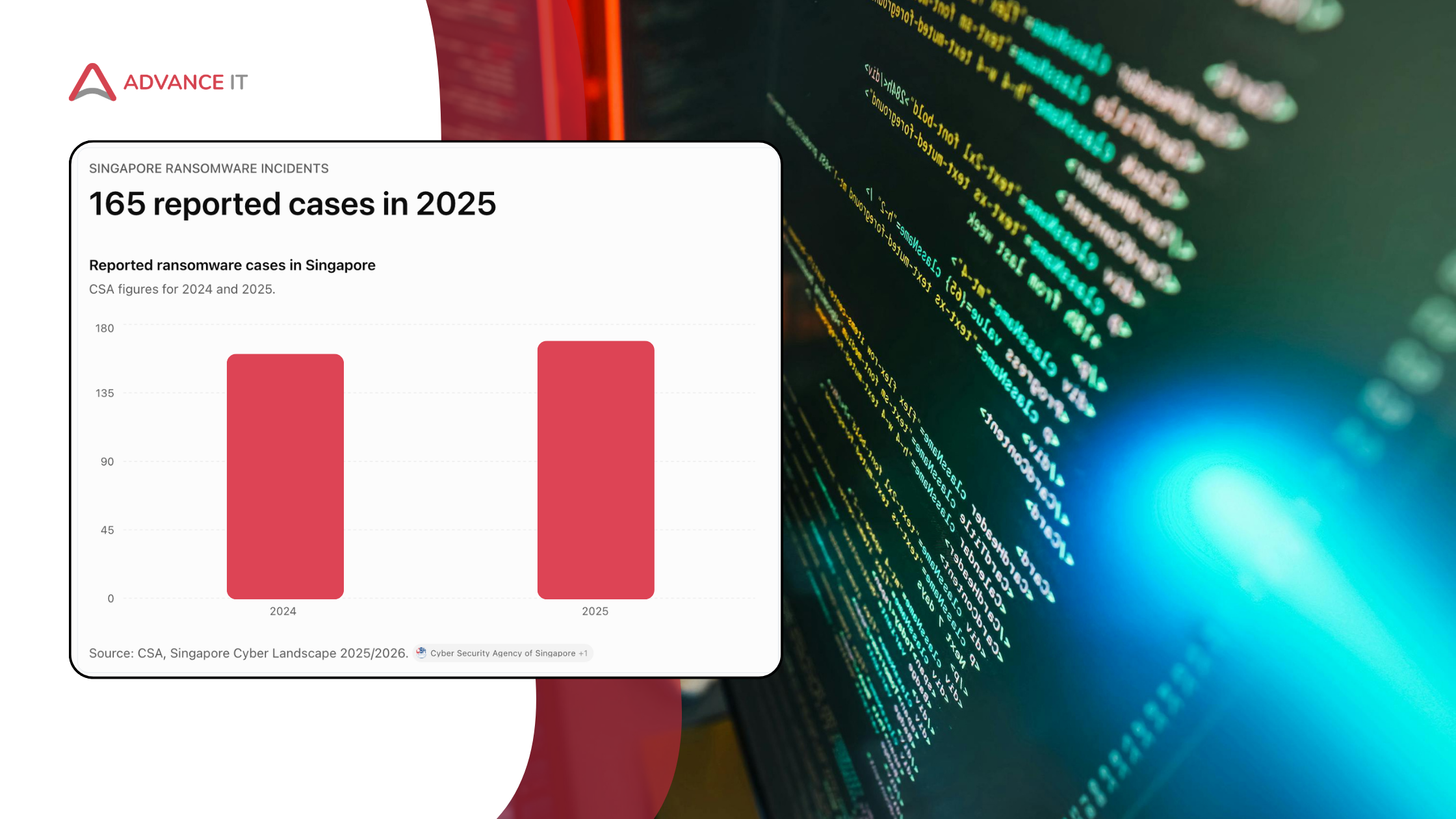
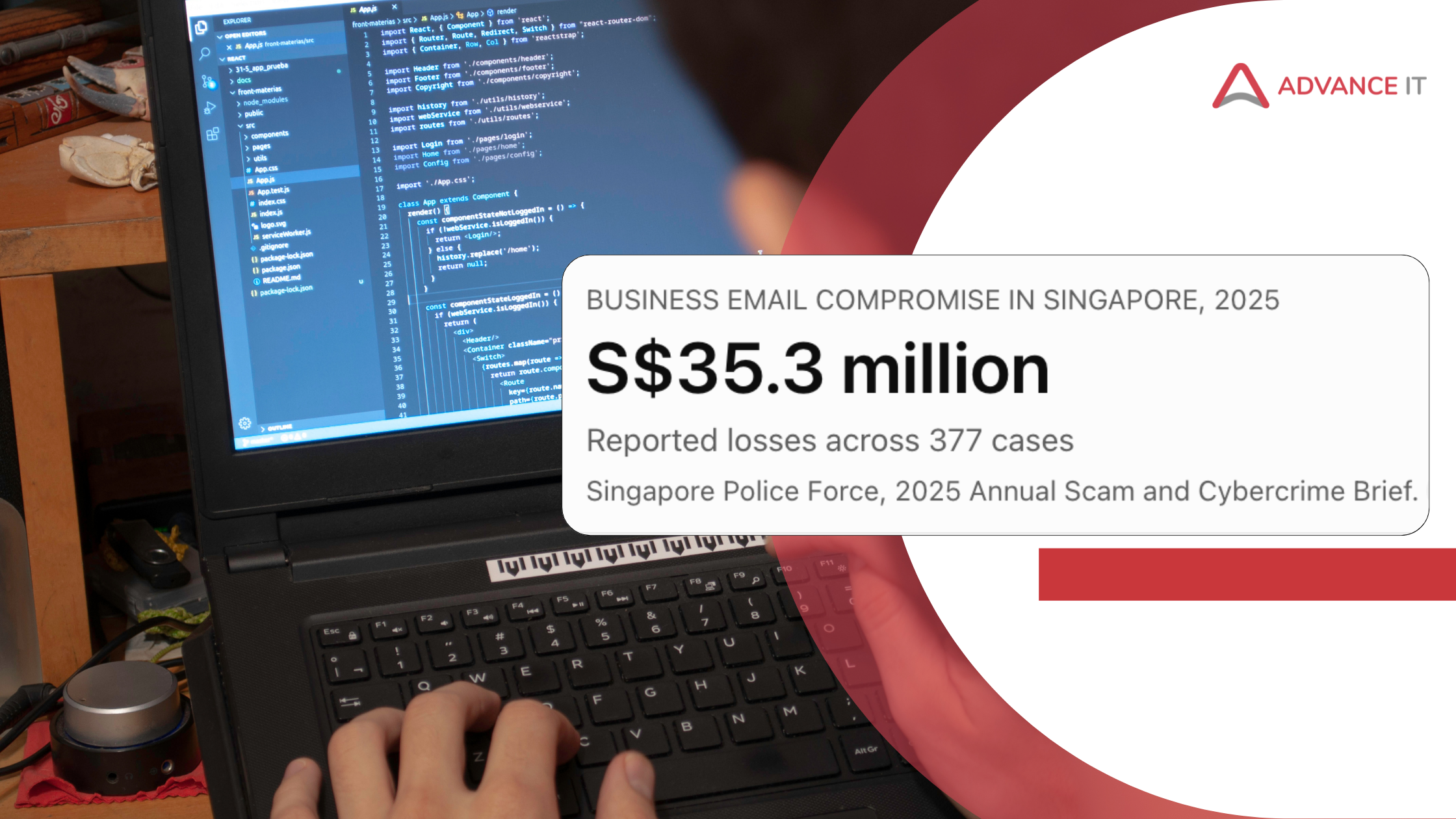
According to the Cyber Security Agency of Singapore (CSA), ransomware incidents reported in Singapore increased from 159 in 2024 to 165 in 2025. SMEs continued to be disproportionately affected. The financial consequences can also be significant. Singapore Police reported 377 business email compromise cases in 2025, involving approximately S$35.3 million in losses.
The question for business owners is no longer whether cybercriminals can produce convincing messages. It is whether your business has the controls to recognise, contain and recover from an attack.
What are the five biggest cybersecurity threats facing Singapore SMEs in 2026?

These risks frequently overlap. A phishing email can compromise a Microsoft 365 account, which may enable invoice fraud or provide a route into other business systems.
Understanding those connections is essential to developing an effective cybersecurity strategy.
1. AI-powered phishing and deepfake impersonation
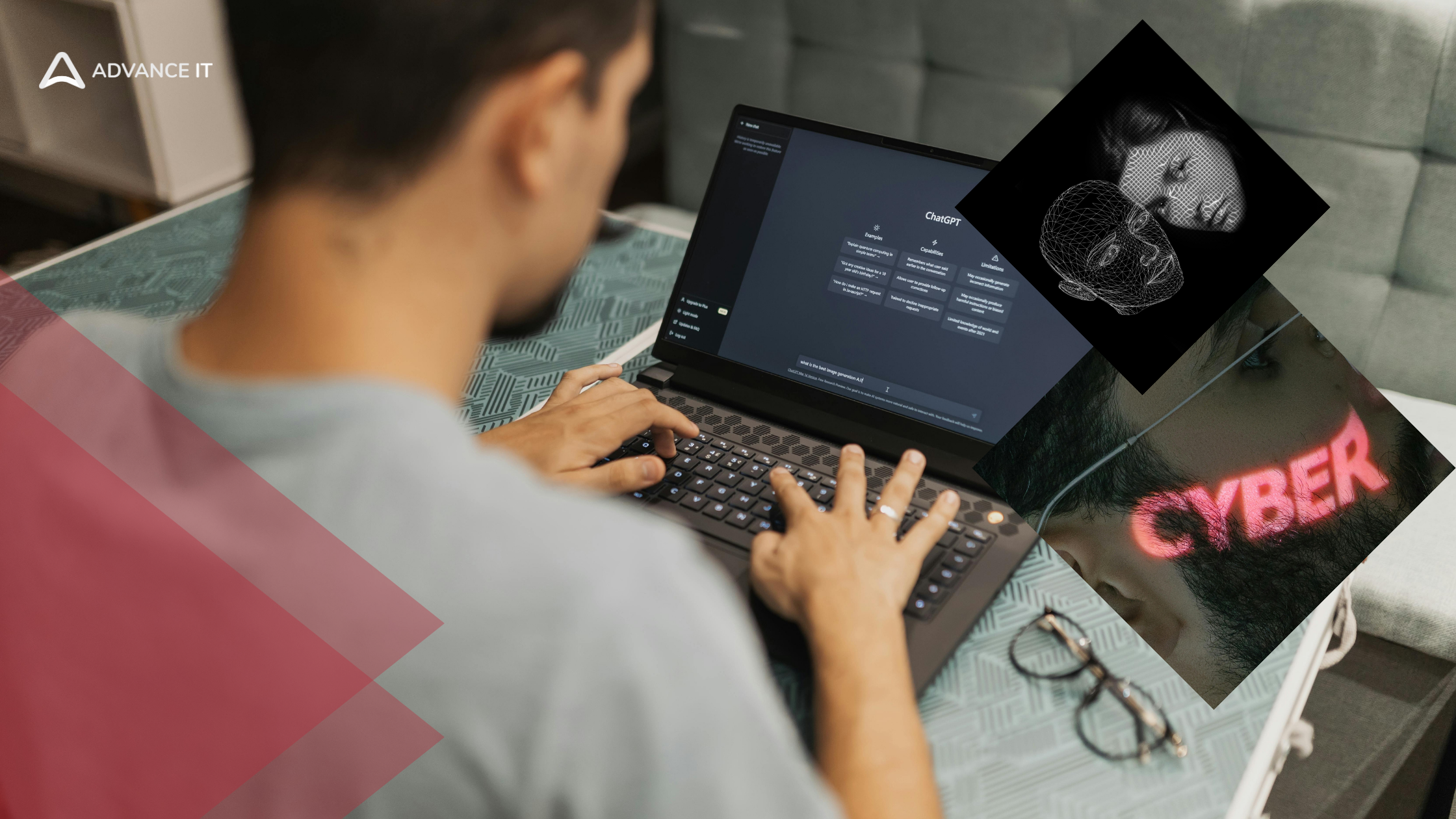
Phishing is not new. But GenAI has changed how convincingly criminals can impersonate people and organisations. In the past, employees were often taught to identify suspicious emails by looking for spelling mistakes, awkward sentences and unusual formatting.
That advice is no longer sufficient.
Generative AI can produce polished business emails, translate messages naturally and create convincing voice or video impersonations. CSA has warned that AI is enabling more sophisticated phishing, realistic voice cloning and video deepfakes. However, its reported phishing attempts actually declined by 21% in 2025, so greater sophistication should not be confused with an increase in every phishing metric.
Real Singapore example: Fake executives on video calls
In March 2025, Singapore Police, the Monetary Authority of Singapore and CSA issued a joint advisory concerning scams involving digital manipulation. In the reported scam pattern, criminals impersonated senior company executives and contacted employees through WhatsApp. Victims were invited to video meetings featuring apparent senior executives, sometimes alongside people impersonating MAS officials or investors.
Authorities believed digital manipulation had been used to alter the scammers' appearances. The victims were then instructed to transfer company funds. This demonstrates why seeing a familiar face on a video call is no longer sufficient proof of identity.
How could this affect a Singapore SME?
Consider an illustrative scenario involving a 25-person manufacturing company.
The finance manager receives a message appearing to come from the managing director. It refers to an existing supplier relationship and requests urgent approval of an unexpected payment. The message is professionally written, and a subsequent call appears to feature the director's voice.
The employee must decide whether the request is genuine. The vulnerability here is not simply a failure to recognise AI. It is a payment-approval process that depends too heavily on one communication channel.
How to protect your business
Establish independent verification for changes to supplier bank details and unexpected payment requests.
Require additional approval for unusual or high-value transfers.
Train employees to verify requests through previously established contact details.
Use phishing-resistant MFA where appropriate.
Establish a clear internal reporting process for suspicious messages.
How Advance IT can help: Advance IT can assist Singapore SMEs with Microsoft 365 security, MFA implementation, email protection, account-access reviews and ongoing IT management. These technical measures complement internal financial approval procedures and employee training.
2. Ransomware and data extortion
What would happen if your business could not access its files, email or critical applications tomorrow morning?
For a retail business, it could mean interrupted sales and inventory operations. For a manufacturer, it could disrupt production. For a healthcare clinic, it could interfere with access to patient information and daily appointments. Ransomware is malicious software that can make systems or data inaccessible. Modern ransomware attacks may also involve stealing information and threatening to disclose it.
Singapore's latest cybersecurity findings show that ransomware remains a significant concern for SMEs.
How GenAI changes the ransomware threat
AI can assist cybercriminals in producing convincing social-engineering messages, impersonating trusted contacts, and increasing the speed of certain attack activities.
However, not every ransomware incident involves AI, and there is insufficient public evidence to attribute all recent Singapore ransomware attacks to GenAI. For SMEs, the more important issue is that a successful attack may exploit several weaknesses simultaneously: compromised credentials, unpatched systems, excessive user privileges and inadequate recovery arrangements.
Example: A clinic loses access to critical systems
Consider an illustrative scenario involving a private GP clinic in Singapore.
An employee receives what appears to be a legitimate software-support email. After interacting with it, the clinic discovers suspicious activity affecting its systems. The clinic's patient-management application becomes unavailable, and employees cannot access important operational files.
Even if the clinic restores its computers, management must determine whether patient information was exposed and whether additional reporting obligations apply. For healthcare providers preparing for Singapore's Health Information Act, this illustrates why cybersecurity and incident response need to be considered alongside NEHR connectivity.
Five questions every SME should ask
Are all business-critical systems included in our backup plan?
When did we last successfully test a restoration?
Are our operating systems, applications and firewalls updated?
Can compromised accounts be disabled quickly?
Do we have a documented business-continuity and incident-response plan?
Backups are particularly important, but they are not a complete ransomware defence. A business also needs to protect backup access, monitor systems and understand how it would continue operating during an incident.
How Advance IT can help prevent ransomware-related disruption
Advance IT provides proactive IT maintenance, endpoint security, patch management, backup and recovery support, and infrastructure management for Singapore SMEs.
Instead of waiting until employees cannot access their systems, our managed IT approach focuses on identifying technical risks and addressing them before they lead to avoidable downtime. For businesses without an internal IT department, this provides a coordinated team to manage everyday IT operations and support incident-response preparation.
3. Business email compromise: When a legitimate-looking invoice costs your business thousands
Business email compromise (BEC) is particularly dangerous because an attacker does not necessarily need to deploy malware to cause financial damage. Instead, criminals impersonate trusted business contacts, compromise legitimate email accounts or manipulate existing business correspondence.
Their objective is often to convince employees to send money to fraudulent accounts.
According to the Singapore Police Force's 2025 Annual Scam and Cybercrime Brief, BEC cases increased from 368 in 2024 to 377 in 2025. Although the reported financial losses fell substantially year on year, they still amounted to S$35.3 million.
Real Singapore example: Fraudulent supplier bank details
Singapore Police identified a BEC pattern in which victims received messages apparently from existing suppliers, vendors or business contacts.
The messages claimed that the supplier's bank account details had changed. Believing the instructions were genuine, employees transferred payments to fraudulent accounts. The deception was sometimes discovered only after the actual supplier followed up about an unpaid invoice.
This is particularly relevant to SMEs with frequent supplier payments, including construction firms, manufacturers, wholesalers and retailers.
What role does GenAI play?
GenAI can make impersonation messages more natural and contextually convincing.
For example, an AI-generated email may reproduce the professional tone of a procurement manager or produce fluent correspondence in multiple languages.
But AI is not required for BEC. Compromised email accounts, spoofed addresses and weaknesses in payment-verification procedures remain important risks.
How to protect your business
Require independent verification of changes to payment details. Employees should contact suppliers using previously verified telephone numbers, not contact information supplied in the suspicious message.
Businesses should also review email authentication, enable appropriate MFA, restrict unnecessary administrator access and establish clear approval procedures.
If your business uses Microsoft 365, regularly reviewing mailbox forwarding rules, account sign-in activity and security configurations can help identify suspicious activity.
Advance IT's role: Our team can help review and strengthen Microsoft 365 security, implement access controls, improve email protection and provide ongoing support for Singapore businesses that rely heavily on email for customer and supplier communications. Technical controls cannot replace financial verification, but both are necessary.
Singapore Police identified a BEC pattern in which victims received messages apparently from existing suppliers, vendors or business contacts. The messages claimed that the supplier's bank account details had changed.
Believing the instructions were genuine, employees transferred payments to fraudulent accounts. The deception was sometimes discovered only after the actual supplier followed up about an unpaid invoice. This is particularly relevant to SMEs with frequent supplier payments, including construction firms, manufacturers, wholesalers and retailers.
What role does GenAI play?
GenAI can make impersonation messages more natural and contextually convincing.
For example, an AI-generated email may reproduce the professional tone of a procurement manager or produce fluent correspondence in multiple languages. But AI is not required for BEC. Compromised email accounts, spoofed addresses and weaknesses in payment-verification procedures remain important risks.
How to protect your business
Require independent verification of changes to payment details. Employees should contact suppliers using previously verified telephone numbers, not contact information supplied in the suspicious message.
Businesses should also review email authentication, enable appropriate MFA, restrict unnecessary administrator access and establish clear approval procedures. If your business uses Microsoft 365, regularly reviewing mailbox forwarding rules, account sign-in activity and security configurations can help identify suspicious activity.
Advance IT's role: Our team can help review and strengthen Microsoft 365 security, implement access controls, improve email protection, and provide ongoing support for Singapore businesses that rely heavily on email for customer and supplier communications.
Technical controls cannot replace financial verification, but both are necessary.
4. Cloud security and third-party vulnerabilities: Your business is only as secure as its connected systems
Most Singapore SMEs no longer operate entirely from computers inside their offices.
They depend on cloud applications, Microsoft 365, outsourced IT providers, accounting platforms, e-commerce systems, remote-access software and external technology vendors.
These tools can improve productivity, but every additional connection introduces responsibilities.
A company might maintain its computers carefully while overlooking an inactive cloud account, an external vendor with unnecessary privileges or an outdated network device.
CSA's 2025/2026 cybersecurity report highlights the growing importance of supply-chain interdependencies. It also reports a substantial increase in infected infrastructure detected in Singapore, partly associated with malware-as-a-service activity and insecure connected devices.
Example: A supplier's compromised account
Imagine a Singapore manufacturer using several external service providers.
One supplier's email account is compromised. The manufacturer subsequently receives a convincing message requesting access to a shared project folder.
The employee recognises the supplier's name and approves the request.
Confidential project documents may now be accessible to an unauthorised party. This is an illustrative scenario, but it demonstrates an important principle: a trusted business relationship does not guarantee that every account or message associated with that relationship is secure.
Where GenAI adds another risk
Businesses are increasingly connecting AI-powered applications to existing cloud environments.
An AI assistant might be granted access to shared documents, internal knowledge bases or email.vIf permissions are too broad or an integration is inadequately secured, sensitive information may become accessible beyond its intended audience.
This does not mean SMEs should avoid cloud technology or AI. It means permissions, integrations and vendor access need to be managed deliberately.
What should Singapore SMEs prioritise?
Start by identifying the cloud platforms and third-party applications your business uses.
Review who can access each platform, which accounts have administrator privileges and whether external vendors still require access. Implement appropriate MFA, maintain supported software, review cloud security settings and remove unused integrations.
For businesses with multiple locations, it is also important to establish consistent security configurations across offices.
How Advance IT can help
Advance IT supports businesses with network infrastructure, firewalls, Microsoft 365 administration, endpoint management and ongoing IT maintenance. For SMEs managing several vendors and cloud platforms, a coordinated IT support model helps clarify responsibilities and reduce the risk of important systems being overlooked.
5. Shadow AI and sensitive-data leakage
Not every AI-related cybersecurity risk comes from an external attacker. Sometimes, sensitive information leaves an organisation because employees use AI tools without understanding the implications. This is commonly called shadow AI: the use of AI applications without appropriate organisational approval, oversight or security controls.
Consider an employee who uploads a confidential customer spreadsheet into a public AI application to generate a sales analysis. Or a marketing executive who pastes a private client proposal into a chatbot to improve its wording.
Or a clinic administrator who enters identifiable patient information into an unapproved AI tool to summarise appointment notes. These actions may create data-protection and confidentiality risks, depending on the application, its settings and how the information is processed.
What does the evidence show?
A Singapore-focused ESET report published in 2026 states that 79% of surveyed organisations experienced an AI-related cyber threat during the preceding year, while 97% were using or piloting AI.
The survey covers Singapore organisations of different sizes and should not be interpreted as a measured incident rate for all SMEs. Its reported threat categories include AI-generated phishing, employee misuse of GenAI and data leakage through AI platforms.
Example: An employee uploads confidential financial information.
Imagine an accounting firm preparing a client's financial statements. An employee uses an unapproved AI service to help organise a spreadsheet containing confidential financial information.
The employee believes the application is simply helping complete a routine task. However, the firm has not assessed the service's data-handling arrangements, retention settings or contractual protections.
The firm now needs to determine whether confidential information has been disclosed inappropriately. This is an illustrative example of a data-governance failure rather than a documented breach.
How to use GenAI more securely
Businesses should establish a clear AI acceptable-use policy. Employees need to understand which tools are approved, what categories of information they may enter and when additional authorisation is required.
Organisations should also review AI application permissions, vendor data-handling terms and relevant privacy obligations. For healthcare businesses, identifiable patient information deserves particular attention because of its sensitivity and the sector's regulatory requirements.
Where Advance IT fits
Advance IT can support the technical foundations of safer AI adoption, including Microsoft 365 security, account permissions, endpoint protection and IT infrastructure management.
AI governance also requires management decisions, staff training and appropriate legal or data-protection advice. No single cybersecurity product can substitute for those responsibilities.
How can Singapore SMEs protect themselves against these five threats?
The solution is not necessarily to purchase more cybersecurity software.
For many businesses, the starting point is understanding whether their existing security measures are configured correctly, maintained consistently and capable of supporting recovery.
Your 2026 SME cybersecurity checklist
Use this checklist to identify the areas your business should review with its internal IT team or managed IT provider.
0 of 16 completed
-
〇 Enable MFA for business-critical accounts.
〇 Review administrator and former-employee access.
〇 Verify unexpected payment requests independently.
〇 Review Microsoft 365 security settings.
-
〇 Maintain an inventory of computers and network devices.
〇 Update operating systems, applications and firewall firmware.
〇 Deploy and maintain endpoint protection.
〇 Review remote-access and third-party permissions.
-
〇 Identify business-critical systems and data.
〇 Maintain appropriately protected backups.
〇 Test data restoration regularly.
〇 Document incident-response and recovery responsibilities.
-
〇 Establish an approved AI tools policy.
〇 Prohibit unauthorised disclosure of confidential information.
〇 Train employees to recognise phishing and deepfake impersonation.
〇 Create a simple procedure for reporting suspicious activity.
Do Singapore SMEs need Cyber Essentials or Cyber Trust certification?
Cybersecurity certification can provide a structured framework for assessing and improving an organisation's security posture. Singapore's Cyber Security Agency offers two relevant certifications: Cyber Essentials, which addresses foundational cybersecurity controls, and Cyber Trust, which is intended for organisations with more extensive digital operations and higher cybersecurity risks.
However, not every SME is legally required to obtain certification.
The appropriate approach depends on business risk, customer requirements, contractual obligations and any applicable sector-specific regulations. Businesses should assess their current environment before deciding which certification or cybersecurity framework to pursue.
For organisations without dedicated cybersecurity personnel, engaging a managed IT provider can help establish the technical foundations for a more systematic approach.
Frequently asked questions
-
here is no single threat that affects every SME equally. Singapore's latest official cybersecurity findings identify ransomware, phishing, infected infrastructure and AI-enabled deception as significant concerns. Businesses should prioritise threats according to their systems, data, industry and operational dependencies
-
Yes. GenAI can generate natural-sounding, personalised messages that imitate legitimate business correspondence. Employees should therefore verify unusual requests through independent channels rather than relying on grammar, tone or apparent sender identity.
-
Yes. CSA reports that SMEs continued to be disproportionately affected by ransomware in 2025, partly because of comparatively limited cybersecurity resources and maturity.
-
No. MFA provides an important additional layer of account protection, but some phishing techniques can still compromise accounts. Phishing-resistant authentication, appropriate access controls and account monitoring provide stronger protection when used together.
-
Microsoft 365 provides numerous security capabilities, but an organisation's protection depends partly on its subscription, configuration, account controls and security practices. Businesses should regularly review their settings and access permissions.
-
Start with an approved-tools policy, employee training, appropriate access controls and clear rules governing confidential information. Review each AI provider's data-handling terms before allowing sensitive business information to be processed.
-
Not necessarily. Many SMEs use outsourced managed IT and specialist cybersecurity providers. What matters is having clear responsibilities, appropriate technical controls, ongoing maintenance and access to suitable expertise when required.
Your cybersecurity strategy should begin before an incident
For Singapore SMEs, the growing use of GenAI introduces new opportunities for productivity alongside new cybersecurity responsibilities. But the foundations of effective security remain familiar: secure accounts, maintain systems, protect sensitive information, verify unusual requests and prepare for recovery.
The challenge is making sure these measures are implemented consistently rather than only after something goes wrong.
Protect your business with Advance IT
Your business should not have to manage cybersecurity, IT infrastructure, employee support and multiple technology vendors without a clear plan.
Advance IT provides managed IT services and infrastructure support for Singapore SMEs, helping organisations strengthen their everyday IT operations and address technical security weaknesses.
Our team can assist with infrastructure assessments, Microsoft 365 security, endpoint protection, patch management, network security, backup and recovery, and ongoing IT maintenance.
Rather than recommending unnecessary products, we start by understanding your existing environment and identifying the risks that matter to your business.
How secure is your business against today's cyber threats?
Get a clearer picture of your IT environment and the areas that need attention.
Singapore-based IT support | Managed IT services | Infrastructure and cybersecurity····························································
With over 15 years of experience and a strong focus on IT support and Managed IT, we’re proud that 99.5% of our customers stay with us long-term.
‣ Website: https://www.advanceit.sg/
‣ Address: 8 Burn Road, #11-11 Trivex Singapore 369977
‣ Email us at: contact@advanceit.sg
‣ Call our team: +65 6592 8458



Is your Singapore clinic ready for the Health Information Act? Learn the 2027 HIA deadline, NEHR requirements, cybersecurity rules and practical steps private clinics should take now.